In conversation · Emmette Lewis
Emmette Lewis on Portrait Painting and Diasporic Memory
Family photographs become portraits in oil, textiles, and found materials. Emmette Lewis on memory, belonging, and the people who shape her work.
Interview by David Rozenfeld
· 8 min read
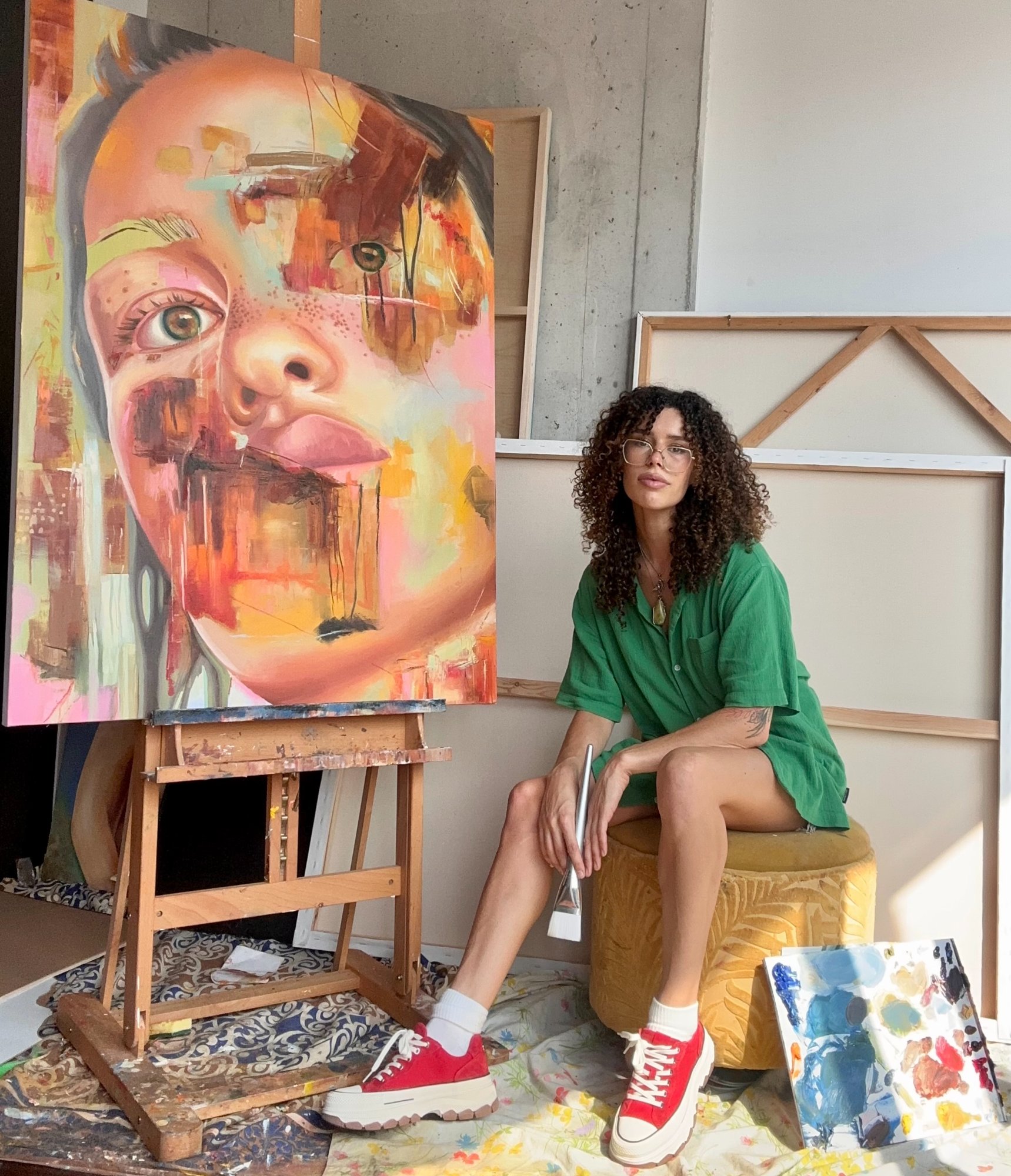
“I want people to step into it and just feel this warmth. Just feel like they're surrounded by family and love and belonging.”
Born in Kamloops, BC and raised between Canada and South Africa, Emmette Lewis is a contemporary portrait painter and recent MFA graduate of OCAD University's Interdisciplinary Master's in Media Arts and Design program. Her work brings together oil painting, textiles, and found materials to explore diasporic identity, cultural memory, and the tension between who we are documented to be and who we truly belong to.
The Full Interview: Emmette Lewis
Between Two Worlds
David: You were born in BC, raised in South Africa, and now you're in Toronto. That's a lot of places to call home. How does that shape who you are as an artist?
Emmette: I consider myself raised in South Africa. My dad is from Durban, and my mum is from Otjiwarongo in Namibia but I grew up mostly in Cape Town. We would go back and forth, spend months there, come back for school here, then go back for family. Now I've been in Toronto alone for about 10 years. I love the diversity here, the art community, it's so vibrant. But there's something about being home. Being understood in that way. Hearing the accents of your family.
A lot of my work actually paints the community I have in South Africa that I don't have access to here. Painting is a way to locate that absence. To bring it here and create my own material language, something I can pass down to my kids, share with others.
A Family of Painters
David: I read that both your father and your aunt are painters. Were they an inspiration for you?
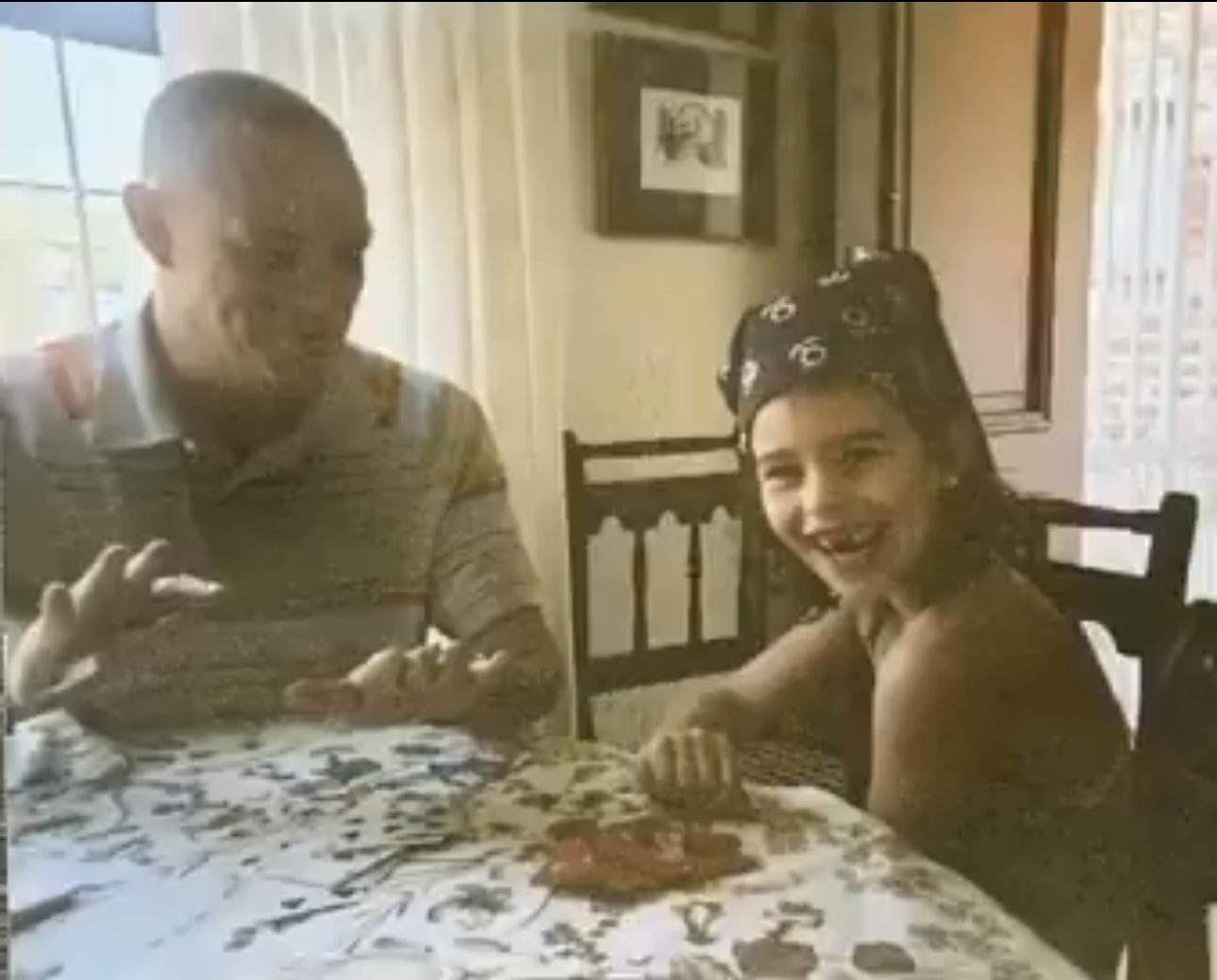
Emmette: Absolutely. My aunt is a professional artist. Her work is all about Africa. She travels everywhere across the continent and works with communities out there. My dad just paints passionately, for fun. But I think he's a brilliant painter. And it's kind of sweet. He always said he started painting to get closer to me. So we would have something to bond over. And then it just became therapeutic for him.
So much of my work is painting my dad and the people around me. It's a way to hold culture and people close.
Emily Carr, the Group of Seven, and South African Materiality
David: I read that you were influenced by BC legends like Emily Carr, but you mix that in with a South African stylistic tradition. Is that right?
Emmette: Yes. I went to Emily Carr for their mentorship program when I was 16. The Group of Seven was also a huge inspiration, seeing these prolific artists who had foregrounded nature and the ecology of community. And then growing up in South Africa, seeing how people integrate materiality: textiles, woodwork, recycled objects. There's a lot of portraiture and a lot of work that uses materials you find on an everyday basis.
So I try to mix the two: narrative-based pieces with pieces that involve materiality. That's why I have stamps and postcards embedded right into the canvas.
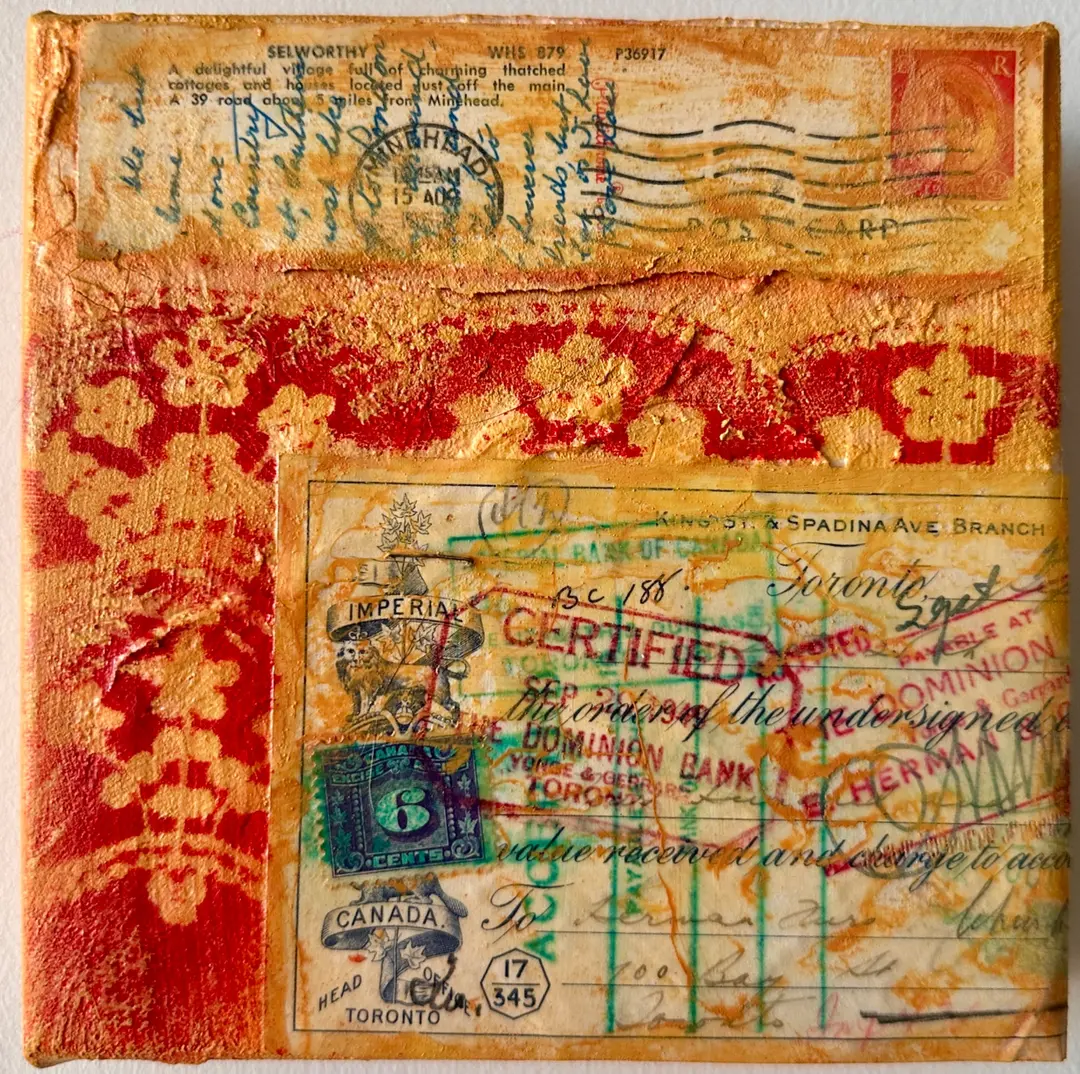
Oil, spray paint, archival postcards and banknotes on canvas · 5" x 5"
This abstract piece used a combination of materials to make up an obscured personal document. The combination of these everyday objects such as banknotes, postcards and stamps recall the ways we communicate with the ones we love. Unmapped…
David: And you frame right onto the painting in some pieces. The cow piece was a standout at the fair.
Emmette: Yeah. I always want to challenge myself. I don't want the painting to feel flat. When you work with your hands and embed something real, you can feel that culture, that history. It adds a tangible layer. I'm not just creating something. I'm embedding something real within the piece.
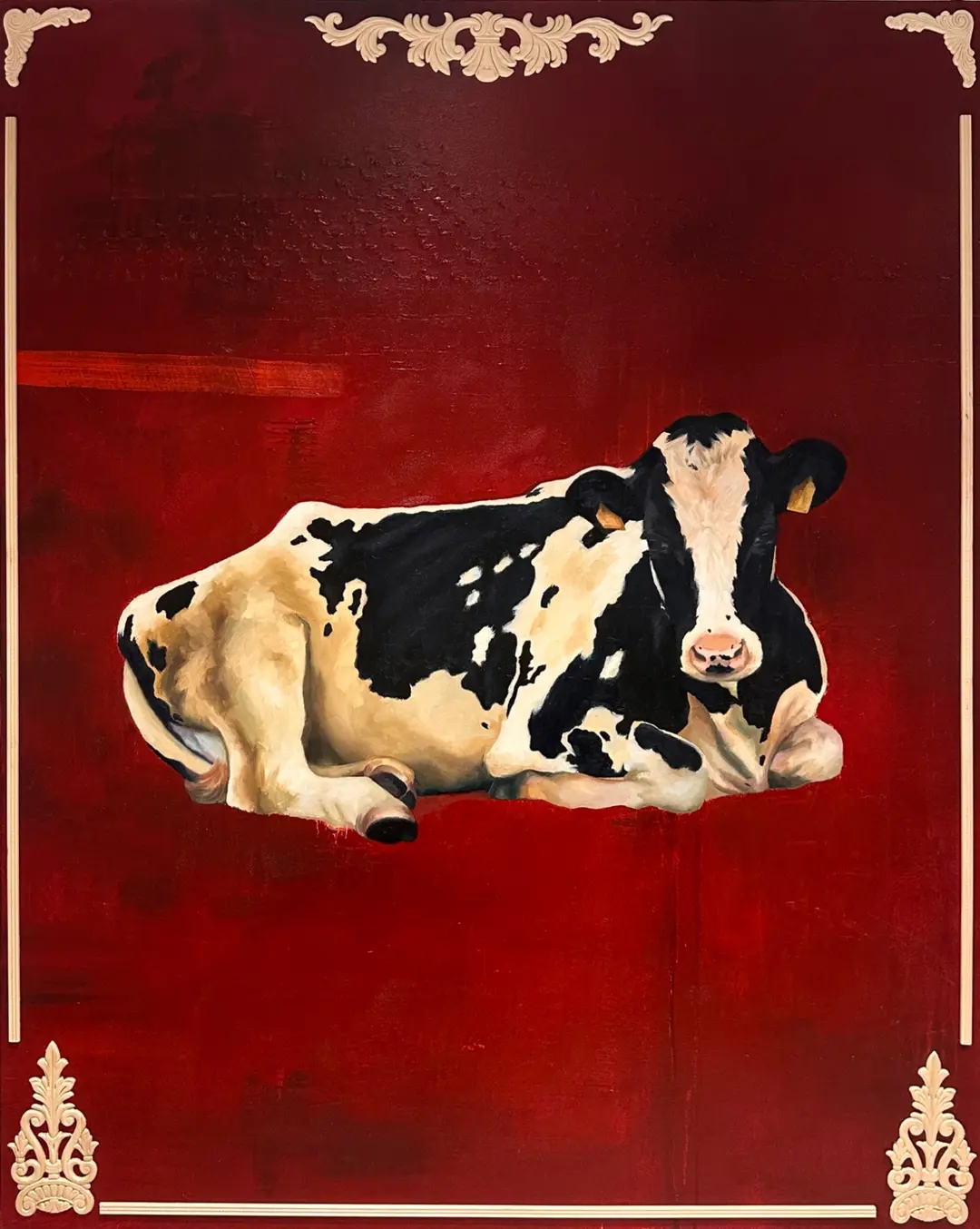
Oil and wood on canvas · 48" x 65"
A cow floats in an obscured landscape. The animals gaze is neither confrontational nor judgemental, instead it greets the audience with calmness and acceptance.
Hidden in Plain Sight
David: Your artist statement talks about the apparent versus the hidden. What's a detail that most people just walk right by?
Emmette: The floral inclusions. In a piece like Portions, you don't really see the florals over my dad's face until you come close and actually engage with it. And in Between Borders, that piece lives in my mother's gallery, there's a framed image of the cow piece hanging within the painting itself. So there are all these little things where it's obvious, but you also have to sit with it.
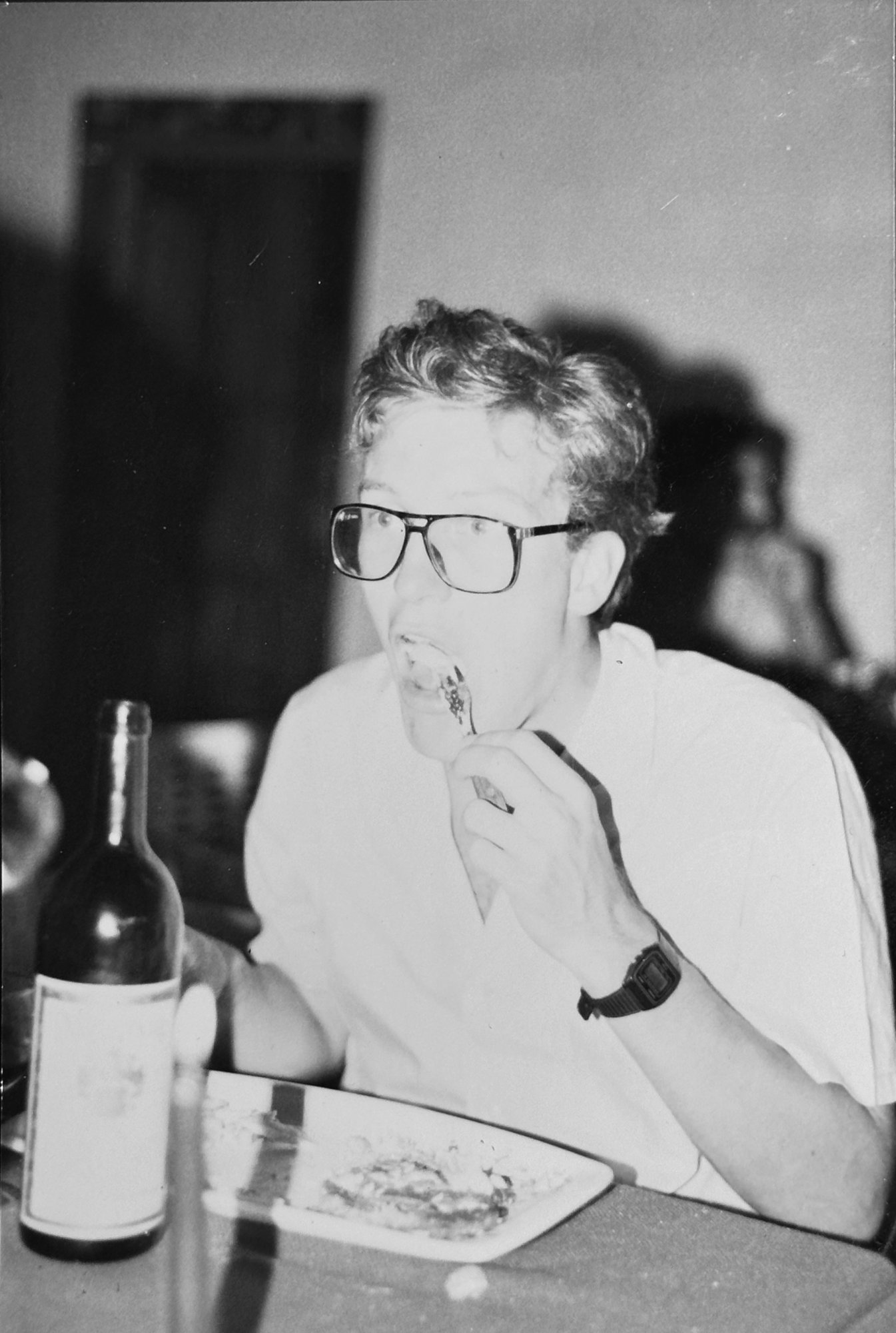
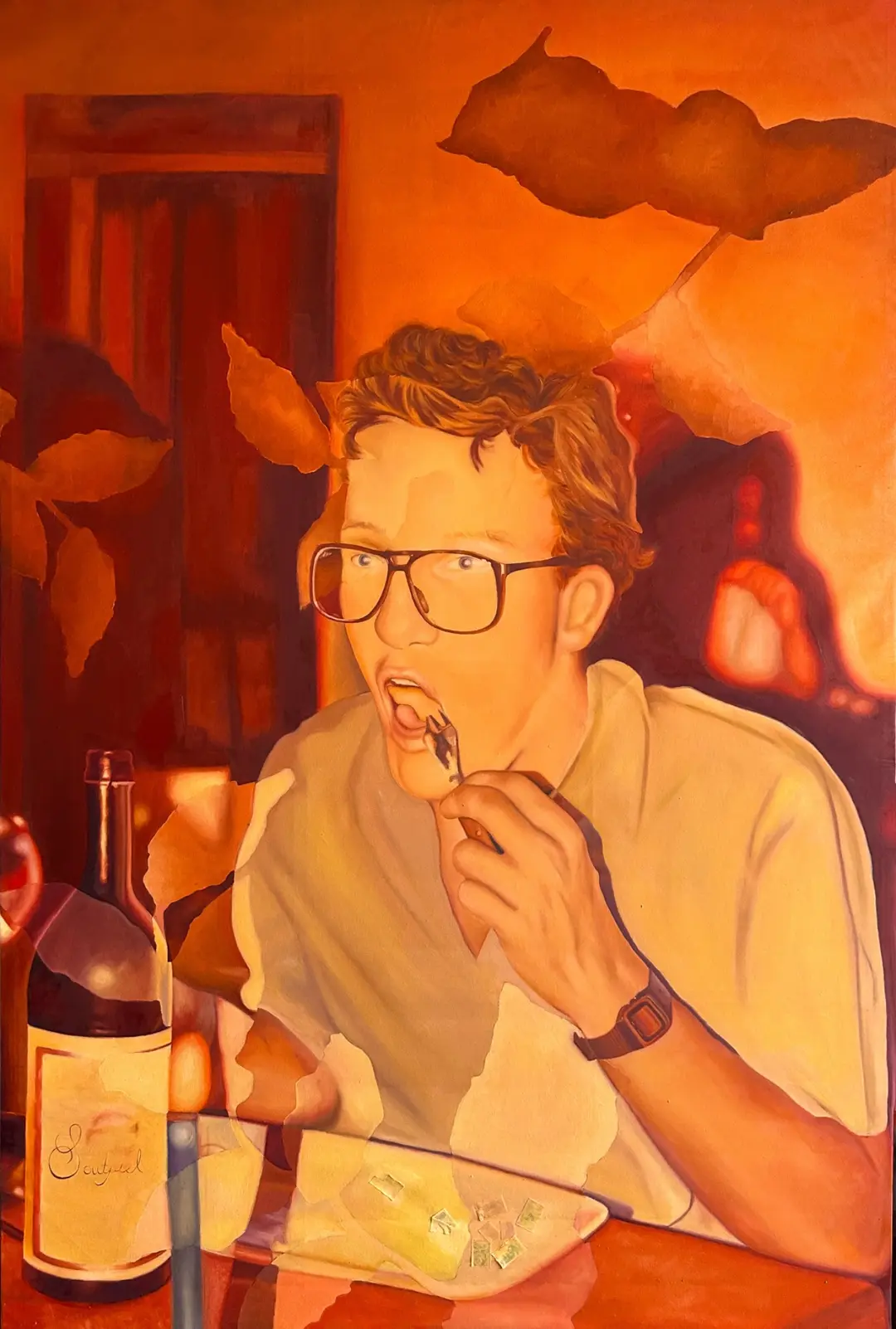
Oil on Canvas · 48" x 72"
The scene glows with warm, saturated light, where layered washes and botanical forms dissolve parts of the body into the surrounding space. Everyday objects such as a bottle, a candle, and a table setting all anchor the image…
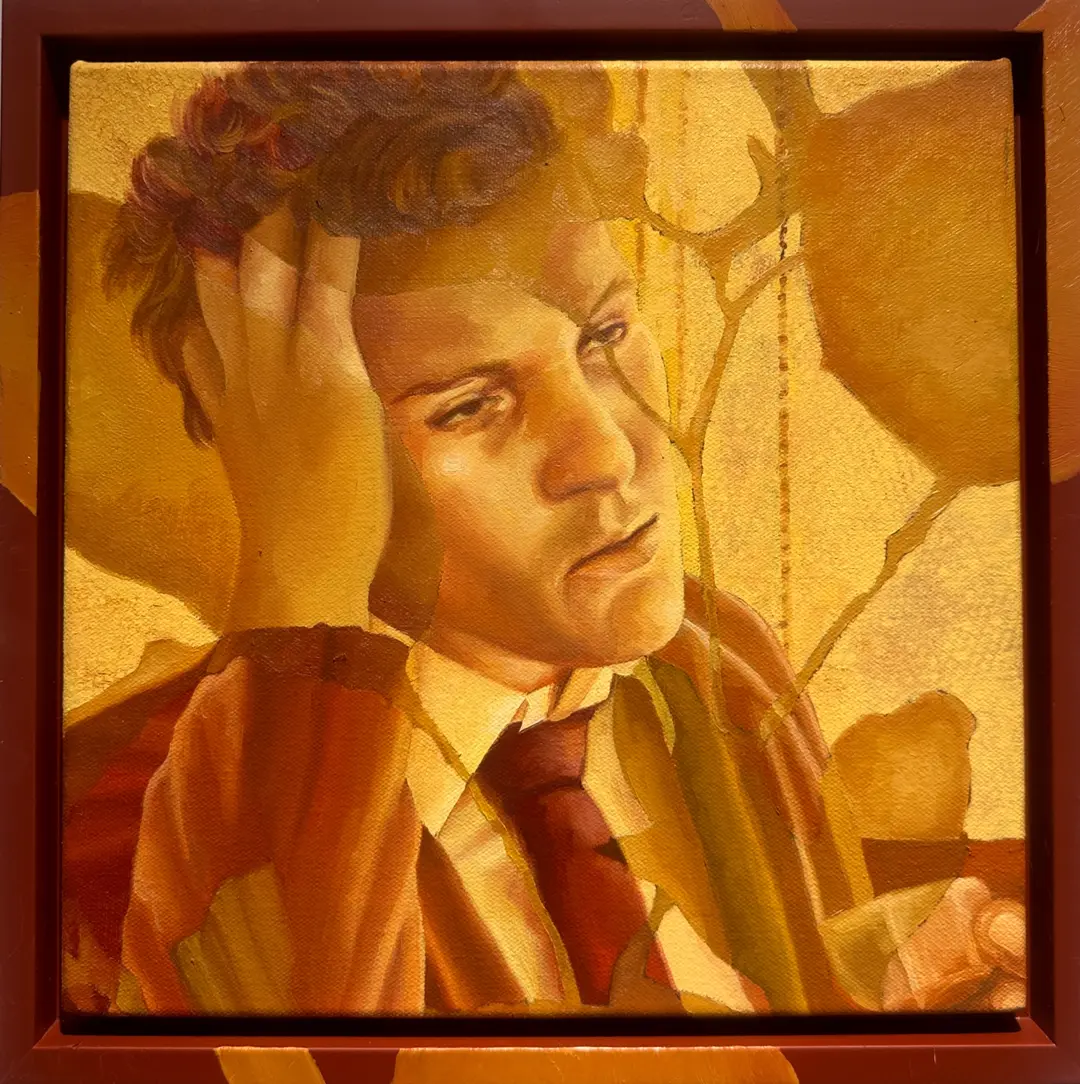
Oil on Canvas · 12" x 24"
An introspective portrait captures a figure caught between thought and sensation, their hand resting in their hair. Warm, layered tones of ochre and red dissolve the boundary between body and environment. Between Borders is a portrait…
David: How do you do the leaves so that they blend so naturally?
Emmette: I just paint them. Literally. I plan out the colour difference beforehand, and then I paint it realistically there. I'm very intentional with my palette, so I do everything in one sitting. I don't go back and add layers for depth. I just keep painting section by section. Which I think is why I'm so drawn to realism and control in my work.
State-Imposed Identity
David: A lot of your work touches on identity and belonging. Can you say more about what you mean by state-imposed identity?
Emmette: When I talk about being Canadian, I have a Canadian passport and Canadian documentation. It's very easy for people to say, yes, she's Canadian. But when I have to prove that I'm also South African and I don't have those documents, and I'm not in South Africa, there are doubts. Double questions that follow. Painting is a way to locate that. To push back on it.
Finding an Authentic Voice in Toronto
David: You mentioned Toronto's queer and drag scene as an influence. Tell me about that.
Emmette: When I came to Toronto, I got really into the drag scene and the queer community here. There is just so much art. The amount of creativity and influence that surrounds you is undeniable. And it was motivating. It pushed me to put myself forward as an authentic voice and stop trying to hide behind a mask to fit a market.
Memory, Celebration, and Cultural Continuity
David: For this current collection, how would you describe it? The motivator, the tone?
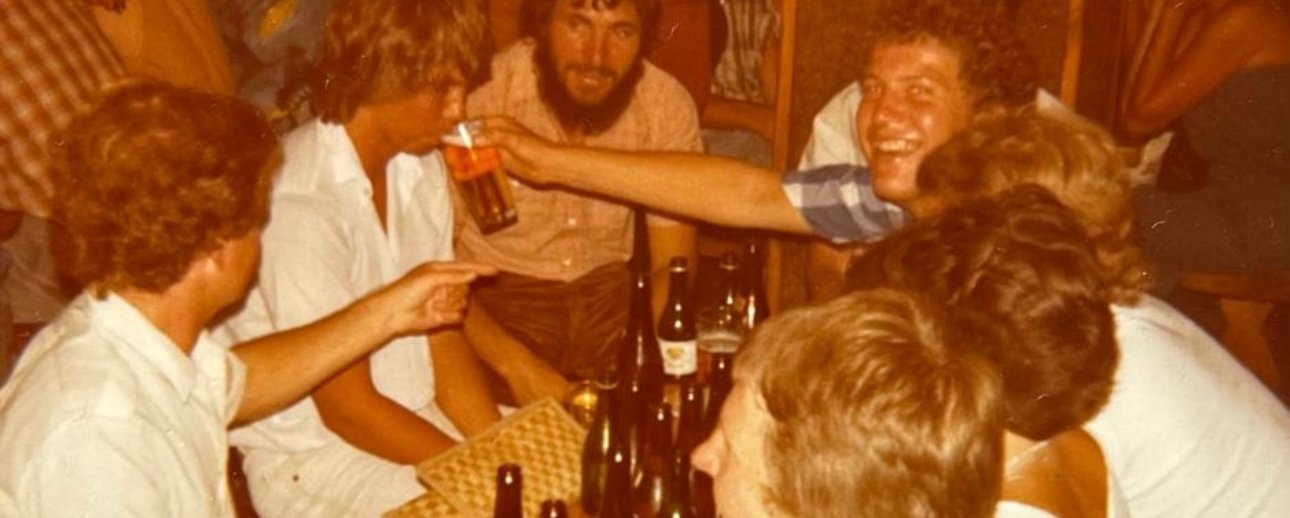
Emmette: Looking at memory and the loss of family through the lens of celebration. And cultural continuity. When I'm doing this body of work, I'm looking at photographs that I can trace and say, I'm a part of that. This is something I belong to. The colour is everything. I want people to step into it and just feel this warmth. Like they're surrounded by family and love and belonging.
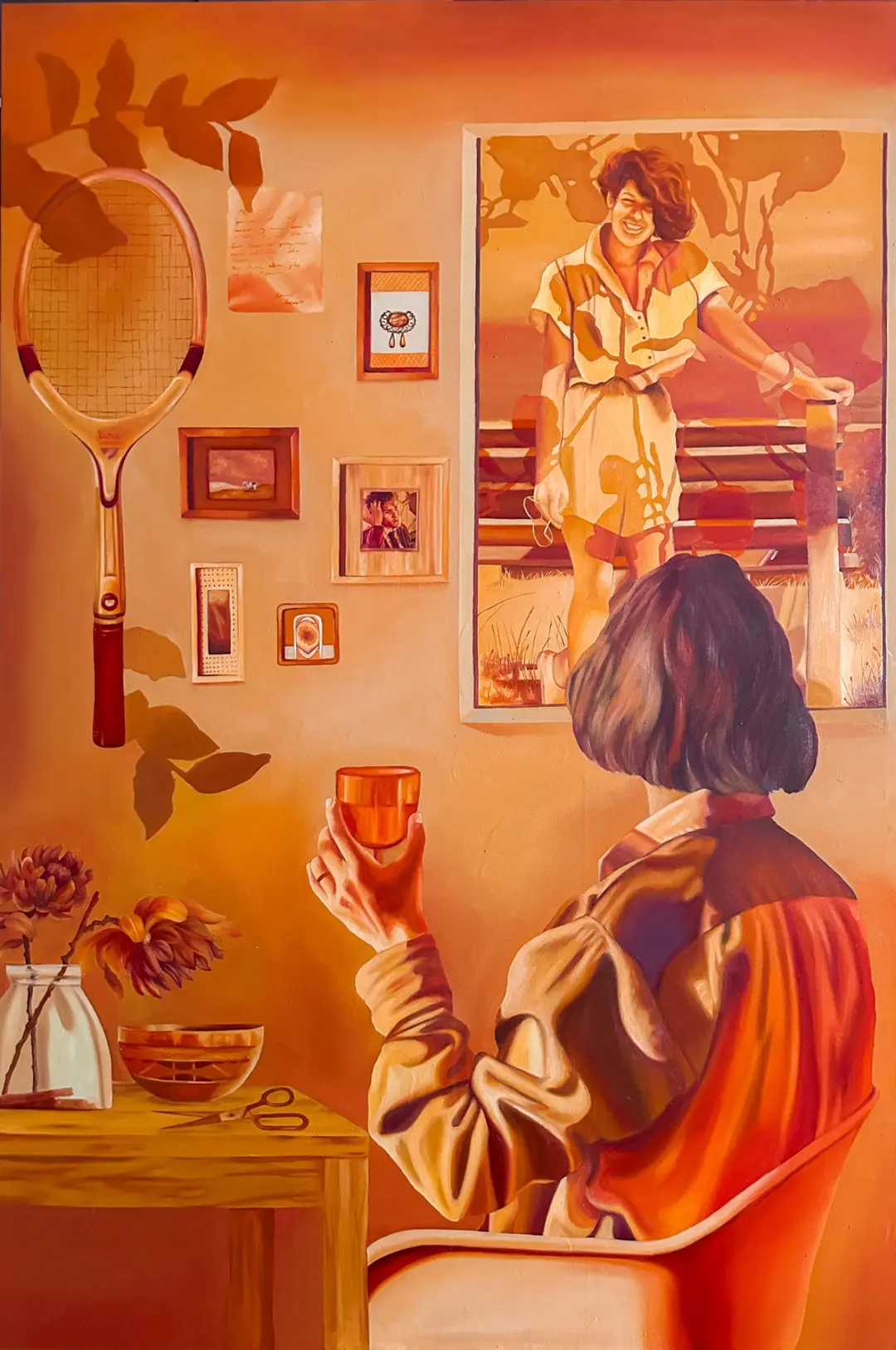
Oil and ink jet print on canvas · 48" x 72"
A solitary figure sits in a warm interior, facing a wall of memories. Framed photographs, a tennis racket, and scattered objects create an archive of personal history, while a larger image ahead reflects a moment of joy and connection. The…
The 5-Year Vision
David: Where do you see yourself in five years?
Emmette: I want to completely devour the art world. Eat it up, digest it, and spit it out and redo it. I want to constantly be metamorphosizing my practice. Someone at Artist Project actually told me I needed a "brand identity" because my work looks different each year. And I was like, that's the point. I want to be pushing myself to the next level. So in five years: teaching at a university, showing at the Gagosian, doing museums, running an artist collective, and empowering kids to be more involved in the arts.
Explore Emmette's Work
See her full portfolio, including Portions, Between Borders, and more, on her Artsume profile. If you are assembling your own, start with how to build an artist portfolio.
From Scattered Platforms to One Consistent Presence: Artsume Spotlight
At Artist Project Toronto, Emmette and David talked about the real frustration of being spread across too many platforms at once. Saatchi Art, Partial Gallery, Hello Art, each with different pricing structures, different audiences, and a profile that tells a slightly different story depending on where you land.
When galleries or collectors Google an artist and find five different versions of them across five different platforms, it creates confusion, especially for older collectors and jurors who expect consistency and professionalism.
Emmette found that pairing her Partial Gallery storefront with a clean, centralized Artsume profile gave her a dedicated sales channel alongside a professional identity hub that does the heavy lifting when someone wants to understand who she is and what she's done. The part she loved most was the CV import. "I just put my CV into the website and it analyzed it for me. I hate rewriting my CV. That was incredible." Setup ran without a glitch.
She's joining Artsume Pro as a beta user, an AI-powered feature that reads an artist's profile and surfaces opportunities matched to their practice. For an artist whose work sits at the intersection of portraiture, materiality, and diasporic narrative, that kind of targeted match matters.
“It's like, you know, like a resume. It opens that line of communication. Otherwise, as an artist, you're going to be going to every single gallery and putting in effort for lines of communication that just aren't meant for you.”