How to Price Your Artwork: Formulas and Strategies
Price your artwork confidently. Pricing formulas, market research methods, wholesale vs retail, and strategies for different selling contexts.
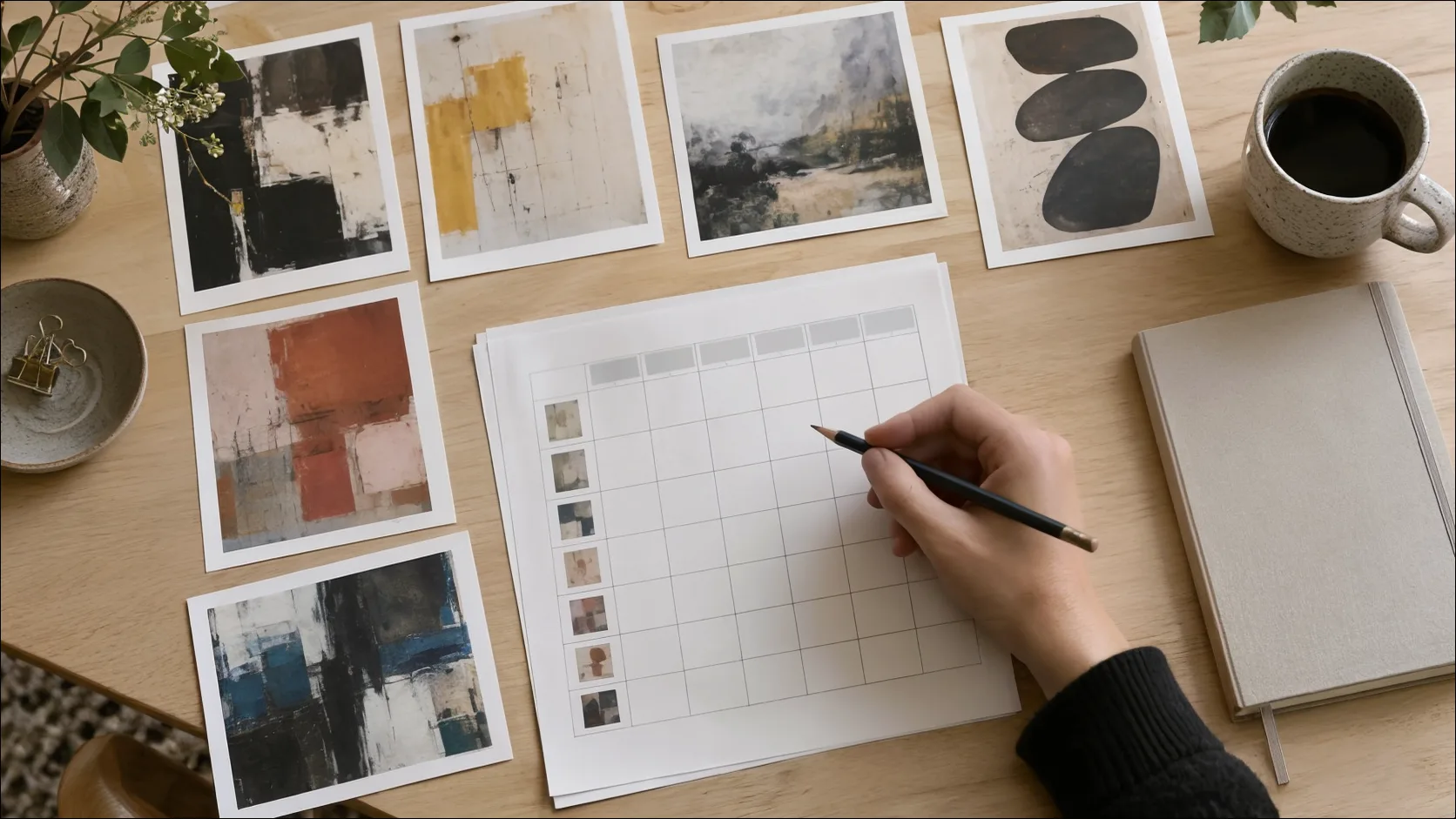
 Colorful abstract paintings displayed with pricing labels for art market research
Pricing artwork is one of the most anxiety-inducing parts of being a professional artist. Price too high and work sits unsold. Price too low and you undervalue your labour while building a ceiling that is hard to break through later.
Below are the formulas that get used, when each one applies, and how to find out what your market will actually bear rather than what you hope it will.
Quick Answer
- Start with the cost-plus formula: (Materials + Labor + Overhead) × 2-3
- Research comparable artists at similar career stages
- Be consistent across all sales channels
- Raise prices gradually (10-20% per year) as demand increases
Pricing Methods Comparison
| Method | Best For | Pros | Cons |
|---|---|---|---|
| Cost-Plus Formula | Emerging artists | Covers all costs | May not reflect market value |
| Square Inch Pricing | 2D work, consistency | Easy to calculate | Ignores complexity differences |
| Market Comparison | All career stages | Reflects actual demand | Requires research |
| Time-Based Pricing | Commissions | Fair hourly compensation | Penalizes fast workers |
| Value-Based Pricing | Established artists | Maximizes revenue | Requires market position |
The cost-plus formula
The most straightforward approach, especially for emerging artists:
Formula: (Materials + Labor + Overhead) × Markup = Price
Step 1: Calculate materials
Include everything that goes into the work:
- Canvas, paper, or substrate
- Paint, ink, or other media
- Framing materials if included
- Any found objects or special materials
Step 2: Calculate labour
Determine your hourly rate and multiply by hours spent:
- Entry level: $15-25/hour
- Emerging (some sales): $25-50/hour
- Mid-career (gallery representation): $50-100/hour
- Established (museum collections): $100-250+/hour
Be honest about time spent. Include planning, sketches, and finishing work.
Step 3: Add overhead
Factor in studio costs proportionally:
- Rent and utilities
- Equipment depreciation
- Insurance
- Marketing costs
Divide annual overhead by number of pieces produced. Most of these are also deductible business expenses, which is worth understanding properly rather than at tax time: artist taxes and business structure covers what counts and how to track it. If your studio and inventory are not covered, art insurance for artists covers what a policy actually protects.
Step 4: Apply markup
Multiply by 2-3× to cover:
- Gallery commissions (typically 50%)
- Taxes
- Profit margin
Example Calculation:
- Materials: $150
- Labor: 20 hours × $35/hour = $700
- Overhead: $50
- Subtotal: $900
- Markup (2.5×): $2,250 retail price
Square inch pricing
Popular for 2D work because it creates consistency across your catalog.
Formula: (Height × Width) × Price Per Square Inch = Base Price
Typical ranges by career stage:
- Student/Emerging: $1-5 per square inch
- Emerging with sales: $5-10 per square inch
- Mid-career: $10-25 per square inch
- Established: $25-100+ per square inch
A 24×36 inch painting (864 sq in) at $8/sq inch = $6,912
Add 10 to 20% for exceptional complexity, price framing separately, and set a floor for small works, since a strict per-square-inch rate makes anything under 100 square inches absurdly cheap. Framing in particular is worth costing properly rather than estimating: framing options and costs covers what different approaches actually run to.
Market research
Pricing in a vacuum produces prices nobody recognizes. Before you commit to a number, find out what artists in a comparable position are charging.
Comparable means four things at once: similar medium and approach, similar career stage measured in years active and CV depth, similar geographic market, and similar exhibition history. An artist with your subject matter and fifteen more years of shows is not a comparison; they are an aspiration.
Look at gallery websites in your market first, since those are real asking prices for artists at a known stage. The Artsy price database and Artnet auction records extend the picture, and art fair exhibitor lists show what a gallery thought was sellable in a specific room. Track 10 to 20 artists, note the ranges by size, and work out honestly where you sit.
Then adjust for where you actually sell. New York and Los Angeles carry higher price points than regional markets, and online-only sales tend to sit lower than either. Pricing your work at Chelsea rates while selling it from a studio in a small city is one of the more common ways to end up with a full storage rack.
Wholesale and retail
Wholesale vs Retail
| Factor | Retail Price | Wholesale Price |
|---|---|---|
| Who pays | Collectors, direct sales | Galleries, shops, consultants |
| Typical discount | Full price | 40-50% off retail |
| Volume | Single pieces | Multiple pieces |
| Your margin | Full profit | Reduced but guaranteed |
The golden rule: Never undercut your galleries.
If a gallery sells your work for $2,000, you cannot sell the same work from your studio for $1,500. This destroys the gallery relationship and your market position.
Options for direct sales:
- Sell at full retail (you keep gallery commission)
- Sell different work directly (studies, smaller pieces)
- Offer studio-exclusive formats or sizes
Pricing by channel
Galleries. Price for a 50% commission, keep the number identical across every gallery that carries you, and leave 10 to 15% of headroom for the collector discounts galleries routinely offer. If you are still working toward representation, how to approach a gallery covers what the relationship involves before you are negotiating inside it.
Art fairs. Same prices as the gallery, always. Booth costs are a business expense to absorb into your annual planning, not a surcharge to pass to the buyer standing in front of the work. Some galleries run fair specials on older inventory, which is a different thing from discounting current work. How art fairs work for artists covers the cost side.
Online marketplaces. Saatchi Art and Artfinder take their own commissions, typically 35 to 40%, so the retail price has to absorb that without dropping below what a gallery is asking. Selling art online compares the platforms and their terms.
Commissions. Charge 20 to 50% above comparable finished work, because you are selling constraint as well as labour. Take a deposit, 50% upfront being the usual figure, and write down what happens if the client wants changes. Commission work for artists covers the whole arrangement.
Studio sales. Full retail, or a little below, and never under what a gallery is asking. Payment plans are a reasonable alternative to a discount if a collector needs one.
Prints. Editions have their own pricing logic, tied to edition size and numbering as much as to the image. Edition sizing and print sales covers it.
When to raise prices
The signals are behavioural rather than emotional. You are selling more than about 70% of what you make. Commissions have a waiting list. Your gallery is asking for more work than you can supply. Or your CV has grown in a way collectors can see, through a major exhibition, an award, or a significant residency, which is a good reason to keep your CV current rather than updating it once a year in a panic.
Ten to twenty percent a year is a sustainable rise. A larger jump of 25 to 50% is defensible after a genuine milestone, though it needs to be one an outside observer would also recognize as a milestone.
Do not lower prices. A price cut is visible to everyone who bought at the old number, and it is very hard to reverse. If a price point is not working, introduce a different body of work at a different price rather than marking down the existing one.
Where pricing goes wrong
Too low is the more common error and the more expensive one. It undervalues your labour, builds a ceiling you will spend years climbing off, signals to collectors that the work is minor, and makes galleries hesitant, since a roster artist priced far under the rest of the room is a problem for them.
Too high fails faster and more visibly. Work sits, galleries lose interest, and you end up with no sales record at all, which is the one thing that would have told you what the work is worth.
Inconsistency damages more than either. Different prices in different channels undermines your galleries, confuses collectors, and creates an arbitrage that someone will eventually notice and mention.
Emotional pricing is the quiet one. Charging more for the pieces you are attached to, discounting the ones you have gone off, or pricing by how long something took, which systematically penalizes you for getting better.
Keep a price list
Maintain one document covering every available work and its price, your per-square-inch rate, how commissions are priced, your discount policy for volume and repeat collectors, and your payment plan terms.
Update it annually and send it to every gallery that carries you. The point is that the answer to "what does this cost" is the same regardless of who asks or where they ask it, which is most of what price consistency actually means in practice.
Frequently Asked Questions
How do I price my first pieces?
Start with the cost-plus formula to ensure you cover costs. Research 5-10 comparable artists at similar career stages. Price conservatively at first. It is easier to raise prices than lower them. Aim for the lower-middle of your research range.
Should I price originals and prints differently?
Yes. Original works command premium prices. Limited edition prints typically sell for 5-15% of original prices. Open edition prints can be lower. Always clearly label editions and include certificates of authenticity.
What if my work is not selling?
Before lowering prices, examine other factors: Are you reaching the right audience? Is documentation professional? Is the work consistent? Lower prices should be a last resort. Consider creating a new, lower-priced series instead of discounting existing work.
How do I handle price negotiations?
Build in a 10-15% negotiation buffer. Have clear policies about discounts (repeat collectors, volume purchases). Never negotiate publicly listed prices more than once. It trains collectors to always ask. Some artists simply do not negotiate.
Should I include framing in the price?
Both approaches work. Including framing simplifies the transaction but increases sticker price. Pricing unframed lets collectors choose framing but adds decisions. Be consistent and clear about what is included.
How do I price 3D work?
Square inch formulas do not work for sculpture. Use cost-plus method with careful materials and labor tracking. Consider size categories (small, medium, large, monumental) with price ranges for each. Factor in pedestal, crating, and shipping costs.
In practice
Pricing is part arithmetic, part market research, and part nerve. Start with a formula so you at least cover your costs, check it against what comparable artists are actually charging, and let it move as your record grows.
The parts that matter most are the boring ones. The same price everywhere. A regular look at where your comparisons have moved. Gradual rises tied to real demand rather than to how you feel about a piece. And a written record of what you charged, to whom, and when, because in three years that record is the only evidence you will have about what your market will bear.
Anything you sell should be covered by something in writing. Consignment, commission, and licensing agreements covers the documents, and shipping artwork safely covers the costs that land after the sale and eat the margin you just calculated.
Keeping the inventory, the CV, and the sale history in one place makes all of this considerably easier. Create your free Artsume profile if you would rather not run it out of a spreadsheet, and your artist portfolio is where the available-work list lives.