How to Build an Artist Portfolio: The Complete Guide
Build an artist portfolio from nothing. How to select and sequence the work, document it, write what sits alongside it, and produce the versions you send.
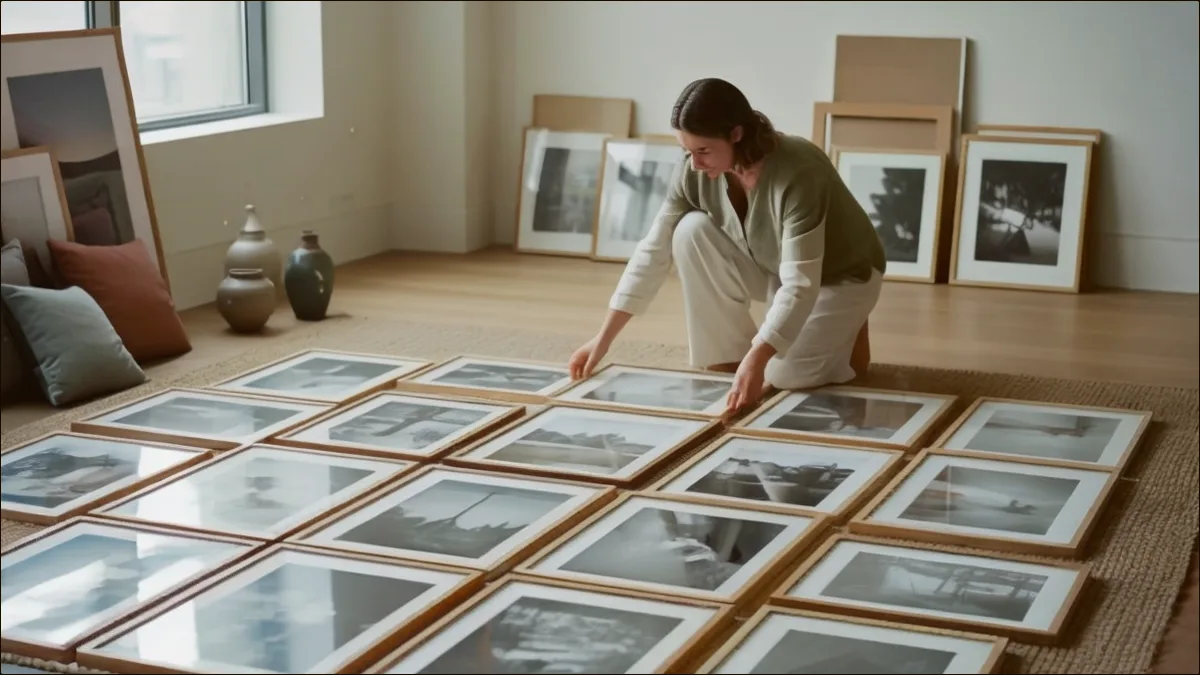 Artist curating and selecting artwork on studio floor for portfolio
This guide is about assembling a portfolio from nothing: deciding what goes in, getting it photographed, writing what has to sit alongside it, and producing the versions you will actually send. It is the build.
Two neighbours are worth knowing about before you start. Artist portfolio best practices covers the presentation standards a finished portfolio is judged against, and how to organize your artist portfolio covers sequencing and version management once you have material to arrange. This one gets you to the point where those become useful problems.
Portfolio Format Comparison
| Format | Best Use | Pros | Cons |
|---|---|---|---|
| Online Website | Ongoing presence | Always accessible | Requires maintenance |
| PDF Portfolio | Email submissions | Universal format | Static, needs updating |
| Physical Book | Studio visits | Tactile impact | Expensive, limited |
| Platform Profile | Applications | Integrated tools | Less customization |
What a portfolio actually is
A portfolio is a curated selection of your best work, arranged to present your practice to a specific audience. It is not an archive. An archive holds everything you have made; a portfolio makes an argument about what kind of artist you are, and it makes that argument by leaving things out.
You will use it for gallery approaches, grant applications, residency submissions, teaching posts, and public commissions. Those contexts want different selections and sometimes different formats, but they all reward the same underlying skill, which is knowing which of your work is strongest. The College Art Association publishes the professional standards most of academia and the art world work from, and it is worth knowing they exist before you invent your own conventions.
The three rules that decide everything
Fewer pieces than you want to include
The most common mistake is volume. A strong portfolio runs 15 to 25 pieces that hold together; a weak one runs 40 and undermines itself, because a mediocre piece does not sit quietly next to a good one. It drags the whole selection down to its level.
So be ruthless. If you are unsure whether a piece belongs, that uncertainty is the answer. Include only work you would be glad to talk about for ten minutes with someone who knows what they are looking at.
A recognizable practice
Someone finishing your portfolio should be able to describe what you do. That does not mean everything looks the same, and stylistic uniformity is not the goal. It means the work is evidently coming from one person with consistent concerns.
If your practice genuinely spans unrelated approaches, build more than one portfolio rather than forcing them together. A single portfolio trying to represent everything usually communicates nothing in particular.
Work from now
Lead with what you are making currently. Student work from six years ago, experiments you abandoned, and pieces you no longer stand behind do not belong here, however fond you are of them. Most opportunities expect work from the past three to five years.
Retrospective contexts and positions asking for demonstrated range are the exceptions. Everything else wants to know where your practice is, not where it has been.
Digital, physical, and application-specific
Digital is the default and effectively mandatory: almost every opportunity submits digitally, and curators and collectors expect to find you online. It is cheap, globally accessible, and easy to keep current. What it costs you is documentation quality, because a screen is unforgiving, and some work simply does not survive the translation. Choosing and building an artist portfolio website compares the platforms if you are deciding where it should live.
Physical portfolios, meaning printed books, cases with actual samples, or mounted presentations, still matter for in-person meetings, teaching interviews, and some residency presentations. A well-printed book communicates something a link cannot, and it shows you took the meeting seriously. It is also expensive, awkward to update, and impractical to ship, so most artists keep one and rely on digital for everything else. Digital versus physical portfolios works through when each is worth the trouble.
Application-specific portfolios are subsets. An opportunity will ask for a particular number of images, particular file specifications, or a themed selection, and you cut that from the master rather than building it fresh. Get the master right and these take an hour instead of a weekend.
Building it, step by step
1. Audit the work
Lay out everything you have made recently and go through it piece by piece with four questions. Is this among my best? Does it reflect where the practice is now? Is it documented well enough to show? Would I be glad for anyone at all to see it?
Sort into three piles: in, maybe, out. Then be generous with the out pile. The maybe pile is where portfolios go to get bloated.
2. Find the threads
Look at what survived and ask what connects it. Recurring ideas, materials, methods, formal habits. What you are looking for is the thing that distinguishes your work from work that superficially resembles it.
Even practices that feel scattered usually turn out to have one or two throughlines once the weaker pieces are gone. Those threads are what the portfolio is going to be built around.
3. Put it in an order
Order changes how a portfolio reads more than most artists expect.
Open with work that is strong, legible, and representative, because the first two pieces set the frame for everything after them. Let the middle progress with some intent, grouping related work and varying scale, colour, or density so the viewing has a rhythm rather than a flatness. Close on something that stays with the viewer, since beginnings and endings are what get remembered.
There is considerably more to this, and how to organize your artist portfolio is the guide that covers sequencing, grouping, and transitions properly.
4. Photograph it properly
This is where most portfolios are won or lost. Excellent work photographed badly reads as mediocre work, because the reviewer is looking at a JPEG, not at your studio.
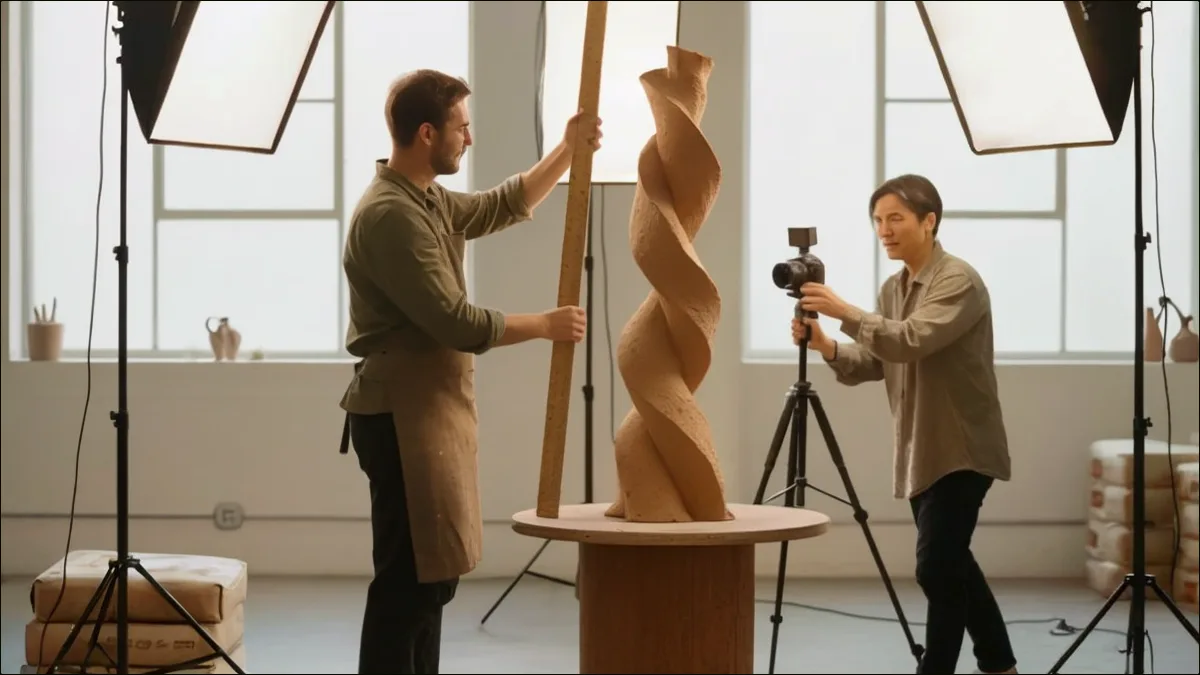
For flat work you need even, diffused light with no glare, a straight-on camera position with the distortion corrected, colour that actually matches the piece, clean edges, and enough resolution for both print and screen. For three-dimensional work you need multiple angles that let someone reconstruct the form, lighting that describes surface and volume rather than flattening them, something in frame or in the caption to establish scale, and detail shots where the detail matters. Installation and site-specific work needs context shots showing the piece in its space, several vantage points, details, and video where the work only makes sense in time.
If hiring a photographer is out of reach, learn to do it. Documenting your artwork covers the setup, the lighting, and the corrections in detail.
5. Write what goes alongside
Three pieces of text travel with the work.
An artist statement, 150 to 300 words, describing the practice in specific and jargon-free language. How to write an artist statement walks through drafting one.
A CV covering exhibitions, education, awards, and relevant professional experience, formatted to CAA conventions for arts contexts. The artist CV guide covers the format, and the CV builder produces one without you fighting a word processor.
And work descriptions: title, date, medium, dimensions, plus a line of context where a piece needs it. Missing captions are the most common reason a good portfolio looks unprofessional.
6. Produce the versions
You need the same material in a few shapes. A website or profile with the full presentation. A PDF for email. Cut-down application versions matching whatever an opportunity specifies. And something suited to showing on a laptop or in print at an in-person meeting.
Building these from one maintained source rather than four diverging copies is the whole point; the portfolio on Artsume works this way, and building your portfolio covers uploads, ordering, and what gets shown publicly.
Four principles worth repeating
Edit until it hurts. Every piece has to earn its place. If cutting a work would not weaken the portfolio, cut it. The ability to assess your own work critically is itself something reviewers are reading for.
Consistency beats peaks. A portfolio of uniformly strong work reads better than one with two exceptional pieces and six adequate ones. The adequate pieces raise questions about the judgment behind the selection.
Match the portfolio to the room. A grant application for socially engaged work should not open with your most formal piece. A gallery approach needs to suggest saleability alongside merit. Portfolios for grant applications and portfolios for galleries cover what each audience is actually looking for.
Keep it alive. Add new work as it is finished and retire pieces that no longer represent you. A portfolio that has not changed in two years suggests a practice that has not either.
Your portfolio is a strategic presentation, not a complete record. Choose work that tells a clear story about who you are as an artist and where your practice is heading.
What goes wrong
The most damaging mistake is including work you already know is weaker, usually in the hope of showing range. What it actually shows is that you cannot tell the difference, which is a worse thing for a reviewer to conclude about you than a narrow portfolio would have been.
Poor documentation is a close second, and it is the one artists most often underestimate. A jury evaluates the image, not the painting. Nobody is imagining what it looks like in person.
After that: generic presentation, where a default theme and a plain PDF layout leave the portfolio indistinguishable from every other one in the pile. Outdated content, where the newest work is three years old and the practice reads as dormant. And missing captions, where pieces arrive without titles, dates, media, or dimensions, which looks careless in a context where care is the thing being assessed.
Frequently Asked Questions
How many pieces should be in my portfolio?
Most portfolios include 15-25 pieces. Quality matters more than quantity. It's better to show 15 excellent pieces than 30 uneven ones. Specific applications may request particular numbers. Always follow stated requirements.
Should I include old work in my portfolio?
Generally, portfolios should emphasize work from the past 3-5 years. Older work may be appropriate for retrospective contexts or demonstrating development, but most opportunities want to see current practice direction.
How do I organize diverse work into one portfolio?
Look for underlying connections: materials, concepts, or approaches that unite seemingly diverse work. If your practice genuinely spans unrelated directions, consider developing separate portfolios for different contexts rather than one portfolio trying to represent everything.
Do I need a professional photographer for documentation?
Professional photography significantly improves documentation quality, but it's possible to achieve acceptable results independently with proper equipment, lighting, and technique. If hiring a photographer isn't feasible, invest time in learning proper documentation methods.
How often should I update my portfolio?
Review your portfolio at least annually, incorporating new work and retiring pieces that no longer represent your best. Before major applications, ensure your portfolio reflects current work. Active practices should show recent activity.
How this changes over a career
Early on your portfolio will be smaller than you would like, and that is fine. Ten to fifteen genuinely strong pieces do more for you than twenty-five with padding, and everyone reading it knows roughly how long you have been working. Nobody is expecting a survey.
As the practice develops the job becomes substitution rather than accumulation: newer, stronger work displaces the earlier pieces, and the identity running through it gets easier to name. Later still, the balance shifts again, between the work you are recognized for and evidence that you have not stopped moving, usually across several portfolio versions aimed at galleries, institutions, and teaching applications respectively.
Where to start
Audit what you have this week and see how much of it you would actually defend. Whatever survives, get photographed properly, because everything downstream depends on it. Then write the statement and bring the CV up to date, build the digital version, and cut the application PDFs from it.
Create your Artsume profile if you would rather keep all of that in one place than spread across folders and old email attachments. And when the portfolio is in a state you would show someone, browse the open programs and see what is actually asking for it.
Build your portfolio
Show your work in a free, professional online artist portfolio.