How to Write an Artist Bio: Examples, Templates, and Tips
Write an artist bio that introduces you professionally. Short bio examples, long bio templates, and the difference between bios and artist statements.
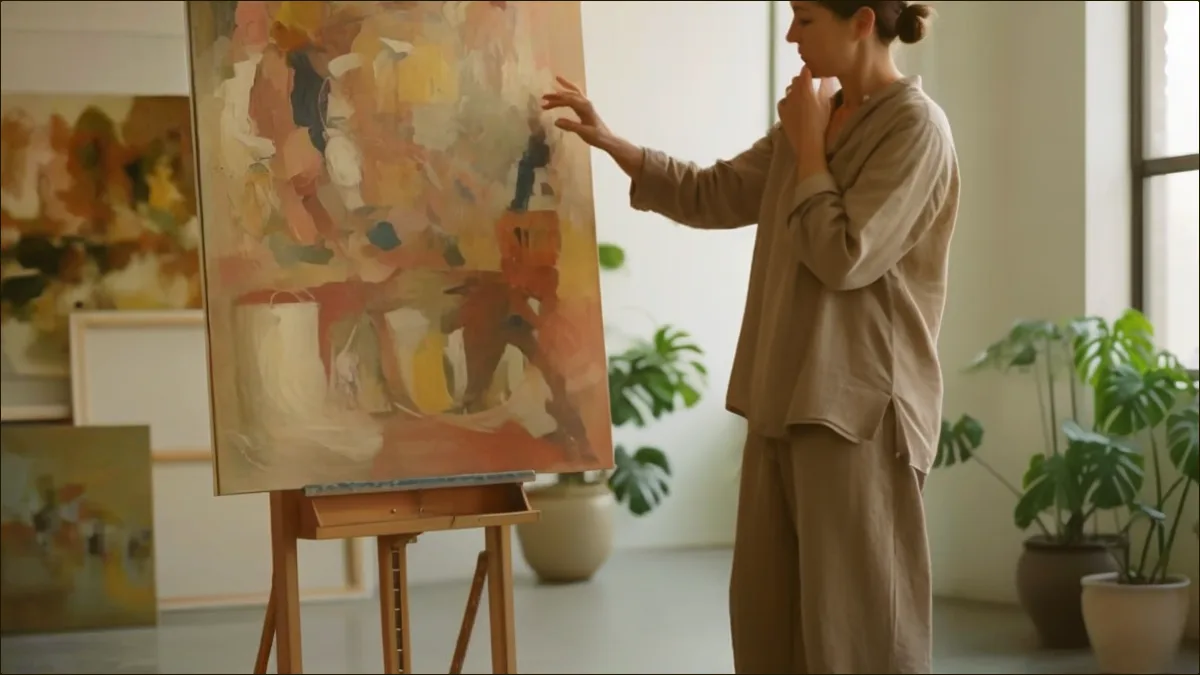 Artist writing a professional bio and CV for gallery submissions
Your artist bio is your professional introduction. Your artist statement explains the work; your bio explains you: background, training, achievements, and what makes you credible as an artist.
You get asked for one more often than you expect. Gallery submissions, catalog contributor notes, grant applications, press releases, wall labels, panel introductions. Write it properly once, keep a few lengths on hand, and you stop drafting it at midnight the night before a deadline.
Quick Answer
- Write in third person for professional contexts
- Lead with your most impressive credential
- Keep it factual and achievement-focused
- Have 3 versions: short (50 words), medium (150 words), long (300+ words)
Artist Bio vs Artist Statement
| Element | Artist Bio | Artist Statement |
|---|---|---|
| Voice | Third person (she/he/they) | First person (I) |
| Focus | You as a person/professional | Your work and ideas |
| Content | Facts, credentials, achievements | Concepts, process, meaning |
| Tone | Professional, factual | Personal, reflective |
| Length | 50-300 words | 150-500 words |
| Updates | When achievements change | When practice evolves |
Bio lengths
Three versions cover almost every request, and they overlap heavily. Once the medium version exists, the short bio is a trim of it and the long bio is an expansion.
Short bio (50-75 words)
Used on social media profiles, exhibition checklists, catalog contributor notes, and anywhere a brief introduction is all there is room for.
Template: [Name] is a [medium] artist based in [location]. [His/Her/Their] work [brief description]. [Name] has exhibited at [1-2 notable venues] and received [1-2 notable awards/recognition]. [He/She/They] holds [degree] from [school].
Example: "Maria Santos is a mixed-media artist based in Chicago. Her work explores immigrant identity through textile and found objects. Santos has exhibited at the Museum of Contemporary Art Chicago and Manifest Gallery, and received a 2023 Illinois Arts Council Fellowship. She holds an MFA from the School of the Art Institute of Chicago."
Medium bio (100-150 words)
Gallery websites, exhibition catalogs, grant applications, and press releases all run at roughly this length. Add exhibition history, awards, collections, or teaching positions.
Example: "James Chen is a sculptor and installation artist based in Los Angeles. His large-scale works investigate the relationship between industrial materials and natural forms, often incorporating salvaged metal, concrete, and living plants.
Chen has exhibited at the Hammer Museum, LACE, and the Torrance Art Museum, with solo presentations at Commonwealth and Council and Charlie James Gallery. His work is held in the collections of the Los Angeles County Museum of Art and the Hammer Museum. He received a 2022 California Community Foundation Fellowship and a 2020 Pollock-Krasner Foundation Grant.
Chen holds an MFA from UCLA and a BFA from CalArts. He teaches sculpture at Otis College of Art and Design."
Long bio (250-400 words)
Reserve this one for your own website, major exhibition catalogs, fellowship applications, and press kits. The extra room goes to context about your practice, influences, critical reception, and publications.
What to include
Every bio, regardless of length, needs your full name as you want to be known professionally, your location (city and state or country), your medium or discipline, your highest degree, and two or three notable exhibitions or achievements.
Beyond that, include what you actually have:
- Awards and grants
- Collections holding your work
- Residencies completed
- Teaching positions
- Publications or press mentions
- Professional affiliations
Leave out your age or birth year unless it is standard in your field. Leave out personal life details that do not bear on the work, and subjective claims like "acclaimed" or "innovative." Exhaustive credits belong on your artist CV, not here. A bio that lists every group show has stopped introducing you and started duplicating a document the reader already has.
What separates a strong bio from a weak one
Lead with your strongest credential
Your first sentence establishes whether the reader keeps going.
Weak: "Jane Smith has been making art since childhood..." Strong: "Jane Smith is a Guggenheim Fellow whose paintings are held in the collections of the Whitney Museum and MoMA PS1."
Write in third person
Professional bios use third person, which reads as more authoritative and is what galleries, catalogs, and press offices expect: "Sarah Johnson is a painter based in New York," never "I am a painter based in New York." First person belongs in your artist statement.
Be specific, and let facts do the praising
Vague claims waste the little space you have.
Vague: "Her work has been exhibited widely." Specific: "Her work has been exhibited at the New Museum, Institute of Contemporary Art Philadelphia, and SculptureCenter."
The same rule kills adjectives. "He is a highly accomplished sculptor" asks the reader to take your word for it. "His sculptures are held in the collections of SFMOMA and the Walker Art Center" does not ask for anything.
Keep it current
Review the bio quarterly, and revise it whenever you finish a major exhibition, receive an award or grant, enter a collection, or change cities. Venues copy whatever you send them and reuse it for years, so a stale bio stays in circulation long after it stopped being true.
Bios go stale faster than CVs because they live in more places. Keeping your About on Artsume, your CV, and your portfolio in one record is the reason the Artsume CV builder reads from the same profile your public page does. Set the profile up once and the bio you send a gallery is the one a curator finds when they search your name.
Common mistakes
Bio Mistakes to Avoid
| Mistake | Problem | Fix |
|---|---|---|
| Starting with childhood | Cliche, wastes space | Lead with current achievements |
| Using first person | Reads as informal | Switch to third person |
| Listing every show | Overwhelming, reads as CV | Select 3-5 best |
| Subjective praise | Unverifiable, sounds insecure | Let facts speak |
| No location | Missing basic context | Include city/region |
| Outdated information | Looks unprofessional | Review quarterly |
Templates by career stage
Emerging artist
Early in a practice the bio carries more weight than the credentials do, so lead with medium and location and name the training and programs you have completed. Most opportunities aimed at emerging artists ask for a bio at this length.
"[Name] is a [medium] artist based in [location]. [His/Her/Their] work [brief description of themes or approach]. [Name] has exhibited at [venues] and was a [residency or program] participant. [He/She/They] holds [degree] from [school]."
Mid-career artist
"[Name] is a [medium] artist whose work [brief description]. Based in [location], [he/she/they] has exhibited at [notable venues including museums if applicable]. [His/Her/Their] work is held in [collections]. [Name] has received [awards/grants]. [He/She/They] holds [degrees] and [teaches at/is represented by] [institution/gallery]."
Established artist
"[Name] is a [medium] artist known for [signature aspect of practice]. [His/Her/Their] work has been the subject of solo exhibitions at [major museums] and is held in the permanent collections of [major institutions]. [Name] has received [major awards] and [fellowships]. [He/She/They] is represented by [galleries]. [Name] lives and works in [location]."
Where the bio ends up
Each destination has a house length, and knowing which one you are writing for saves a rewrite.
A gallery reads your bio inside a submission packet, alongside images and a CV; the gallery outreach guide covers what belongs in the rest of that packet. Editors pull the medium bio straight out of a press release without changing a word, which means the version attached to a press pitch is the version that gets printed. On your own site the bio usually sits on an About page beside the work, where the portfolio website guide has more on how the pages fit together.
One caution: when an application asks for a CV, a bio is not a substitute. The two documents answer different questions, and an arts and cultural CV records things a bio never mentions.
Frequently Asked Questions
Should I write my bio in first or third person?
Third person is standard for professional artist bios. First person reads as informal and is typically reserved for artist statements. Use she/he/they and your last name for subsequent references.
How is a bio different from an artist statement?
Your bio focuses on you as a professional: education, exhibitions, awards. Your artist statement focuses on your work: concepts, process, meaning. You need both, and they are rarely interchangeable.
How often should I update my bio?
Review your bio quarterly and update whenever you add a significant achievement. Major exhibition, award, collection acquisition, or gallery representation. Remove outdated information and ensure current location is accurate.
What if I do not have exhibitions or awards yet?
Focus on education, training, and your practice. Mention workshops, residencies, or mentorships. Describe your medium and approach. Everyone starts somewhere. An honest bio about where you are now is better than inflated claims.
Should I include my age or birth year?
Generally no, unless it is standard in your field or relevant to your work. Some emerging artist opportunities require birth year. If included, format as born [year] in [city/country].
How do I handle multiple disciplines?
Lead with your primary discipline and acknowledge range: Maria Santos is a sculptor and installation artist... or Maria Santos works across sculpture, video, and performance... Avoid listing too many, three maximum.
Write it once, keep the three lengths current, and let the achievements do the arguing. Save the poetry for your artist statement.
Ready to build your professional presence? Create your free Artsume profile to store your About, CV, and portfolio together.