Studio Practice and Productivity for Working Artists
Build a sustainable studio practice. Manage your time, set up your workspace, overcome creative blocks, and maintain momentum in your art career.
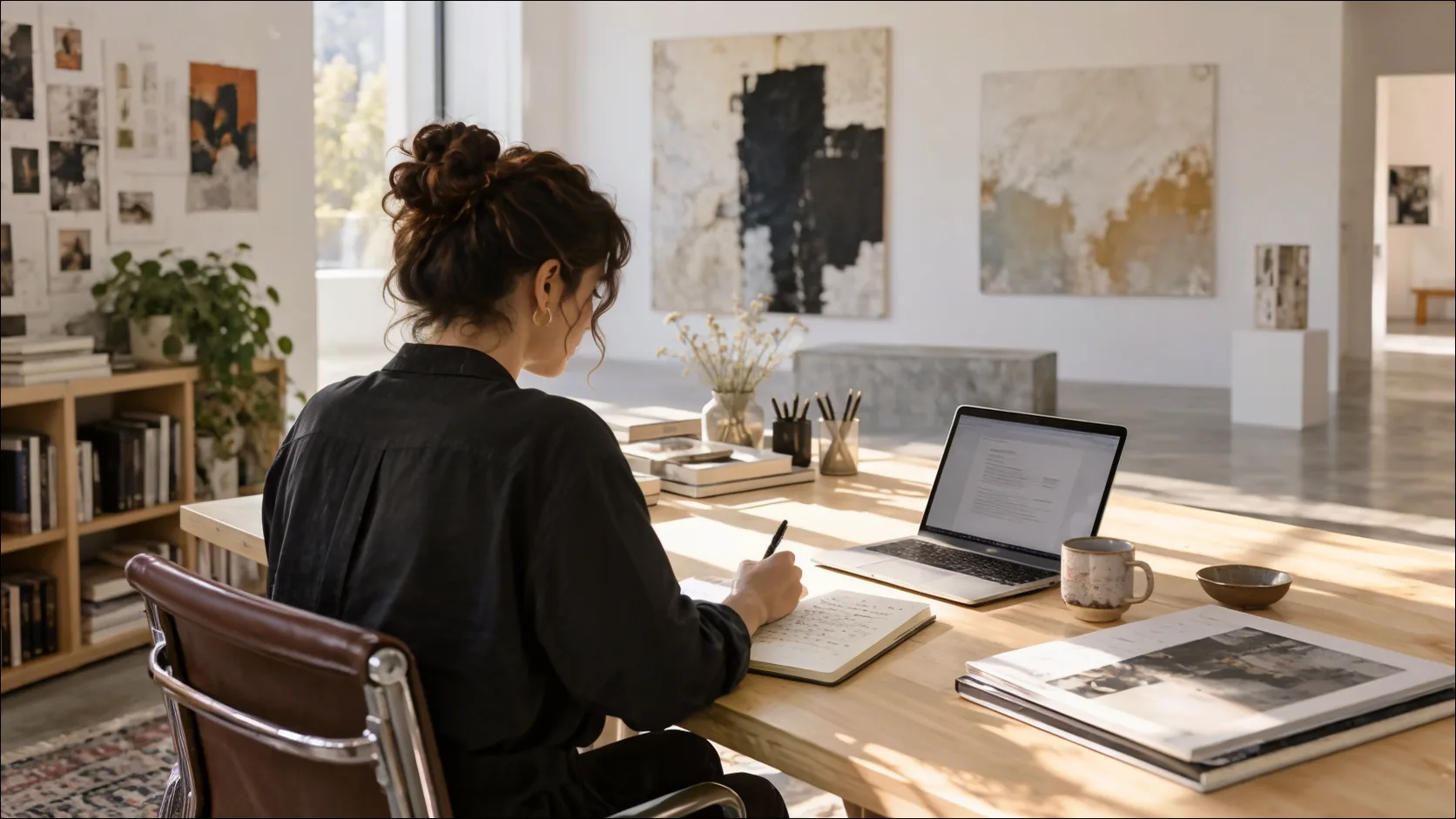
 Artist working productively in an organized studio space
A sustainable studio practice is what makes a long art career possible. Here is how to structure your time and your space, and how to keep going through the flat stretches.
Quick Answer
- Schedule studio time like appointments you cannot cancel
- Set up your space so starting work requires zero decisions
- Work in focused blocks with clear stopping points
- Track what you make, not how you feel about it
- Build systems that survive bad days
Most of what follows rests on a few ideas. Regular short sessions beat occasional marathons, so consistency wins over intensity. Your environment shapes your behavior more than your willpower does, which makes studio design a productivity decision. Knowing when you do your best work, and defending that window, matters more than finding extra hours. Showing up is the metric, not producing masterpieces. And rest is part of the work rather than a break from it.
Time Management for Artists
Finding Studio Time
Most artists do not have unlimited time. You need to find and protect the time you have.
Track how you actually spend a week before deciding what to change, and note your energy levels while you do it. The time is usually hiding in early mornings, lunch breaks (45 minutes is enough), evenings after dinner, and weekend mornings. A commute counts too, if you use it to plan rather than scroll.
Scheduling Strategies
Block scheduling: Dedicate specific time blocks to studio work. Treat them like appointments you cannot cancel.
Minimum viable practice: On busy days, commit to just 15 minutes. Showing up matters more than duration.
Batch similar tasks: Group administrative work (emails, applications, ordering supplies) into dedicated time blocks separate from creative work.
Scheduling Approaches
| Approach | Best For | Considerations |
|---|---|---|
| Daily short sessions (1-2 hours) | Maintaining momentum | Requires consistent schedule |
| Fewer long sessions (4-8 hours) | Deep work, complex projects | Harder to maintain, more susceptible to interruption |
| Weekend intensive | Those with demanding weekday jobs | Risk of exhaustion, pressure to produce |
| Residency model (full immersion periods) | Major projects, career transitions | Requires planning and savings |
That last row is a real option, not a fantasy. A residency buys you a stretch of uninterrupted time that no amount of scheduling can manufacture at home, and the applications are usually due six to twelve months ahead of the dates. How to apply for artist residencies covers what programs ask for.
Protecting Studio Time
Tell family, friends, and colleagues when you are not available, and mean it. Put the phone in another room, close email, block social media. Then build a short transition ritual, the same one every time, that tells your brain the working part of the day has started; the shift happens faster when it has a signal.
Studio Setup and Organization
Your physical space shapes your practice. Design it for minimal friction.
The Zero-Decision Studio
When you walk in, you should be able to start immediately without making choices. That means the palette is already mixed, the tools are laid out, the work in progress is where you can see it, and your references are visible. It also means enough room to move, good light on the work surface, and a temperature you can tolerate for hours.
Half of that setup happens at the end of the previous session rather than the start of the next one. Clean the brushes, organize the tools, leave the work in view, and write down where you want to pick up.
Small Space Solutions
You do not need a dedicated studio to make work.
Portable studio:
- Cart or tote with materials
- Can set up in living room, kitchen, shared space
- Pack up when not in use
Shared studio:
- Split costs with other artists
- Build community
- May require scheduling
Kitchen table practice:
- Works for smaller work, drawing, planning
- Constraint can focus your practice
- Requires discipline about setup/cleanup
Digital Organization
Even physical artists need digital systems, and the ones that matter are boring. Name files consistently (YYYY_Title_Medium), keep folders by year or series, and back up in two places. Photograph work as you finish it and keep the high-resolution versions, because those are what applications ask for months later; the artwork documentation guide covers doing it properly.
Keep the administrative material somewhere you can find it under deadline pressure: CV, artist statement, bio, application materials sorted by deadline, and receipts for tax season. A free Artsume profile can hold the archive side of this, keeping your CV, portfolio, and application history in one place instead of three folders and an inbox.
Working Through Creative Blocks
Every artist faces periods of resistance, doubt, or emptiness. The goal is not to eliminate these feelings but to work anyway. Blocks come in a few recognizable kinds, and each one responds to a different intervention.
Fear-Based Blocks
Fear of failure, fear of success, fear of judgment, fear of wasting expensive materials. The common thread is stakes, so lower them: work ugly on purpose, make something you plan to destroy, use the cheap paper, set a timer and stop when it rings whether or not the thing is good.
Energy-Based Blocks
Exhaustion, burnout, depression, life stress. These do not respond to discipline and get worse when you apply it. Rest without guilt, take a walk, go look at other people's art, and if you need to feel productive, do administrative work instead of forcing studio work.
Clarity-Based Blocks
Not knowing what to make, too many options, the flatness that follows finishing a major project, the gap between one body of work and the next. Copy something you admire. Impose a constraint (one color, one hour, one size). Go back through old sketchbooks. Start many small things without committing to any of them.
The Warm-Up Habit
Never start with your "real" work. Start with something that does not matter: gesture drawings, color mixing, material experiments, exercises from a book, copying from reference. The warm-up lowers the stakes and gets your hands moving.
Building Sustainable Momentum
The Compound Effect
An hour a day is 365 hours a year. A piece a month is twelve pieces a year. One application a week is 52 applications a year, which is more than most artists submit in five. What feels small daily becomes significant annually.
Tracking Your Practice
Track inputs (time spent, pages filled, pieces started) rather than outputs (completed work, sales, acceptance).
What to track:
- Days in studio
- Hours worked
- Pieces started
- Pieces completed
- Applications submitted
Review periodically:
- Weekly: Did I meet my minimum?
- Monthly: What patterns do I see?
- Quarterly: Am I moving toward goals?
Managing the Admin Side
Administrative work expands to fill available time. Contain it: email twice a day at set times, applications in one weekly slot, bookkeeping once a month, social media scheduled rather than grazed. Automate what repeats, with email templates for common responses, saved application materials, and recurring calendar blocks.
The applications slot is the one that decays first, because deadlines arrive unevenly and nothing forces the issue until something is already missed. Keeping every deadline and status in one place fixes most of it; Artsume's application tracker does this, and the managing applications guide covers the workflow. Best practices for applying to art opportunities covers keeping the quality up once the volume is real.
Work-Life Integration
When Art Is Not Your Day Job
Most artists work other jobs. This is normal, not failure.
What the job costs you is not only hours. A physical job and a desk job leave you with different kinds of energy, and a job that occupies your head all day is more expensive than one that doesn't, whatever it pays. Weigh schedule flexibility and mental space alongside the money.
Then protect the studio time you have, lower your production expectations to fit it, and treat the limitation as a constraint rather than a verdict. This may be temporary. It may also not be, and that is a normal way to have a career.
When Art Is Your Job
Full-time artists face different challenges. There is no external structure, every day starts blank, and procrastination has nothing standing in its way. Meanwhile the business side, selling, marketing, and networking, competes directly with studio hours, and income uncertainty eats focus.
The fixes are artificial structure (studio hours, routines you keep), separating business days from studio days, and tracking your finances monthly rather than annually. Our taxes and business structure guide covers the bookkeeping side.
Rest and Recovery
Rest is part of the practice, not a break from it.
Signs you need rest:
- Dreading studio time
- Work feels forced
- Physical exhaustion
- Emotional flatness about your practice
Productive rest:
- Walking without destination
- Seeing exhibitions
- Reading unrelated books
- Time with non-artist friends
- Travel without expectations
Common Mistakes
All-or-nothing thinking: Believing you need four-hour blocks when one hour would work.
Waiting for inspiration: Inspiration follows action more often than preceding it.
Comparing your process to others: Some artists work fast, some slow. Both are valid.
Perfectionism as procrastination: Endlessly preparing instead of starting.
Ignoring physical needs: Dehydration, hunger, poor lighting, and bad ergonomics erode productivity.
No external deadlines: A practice with nothing due drifts. Open calls and juried shows impose dates you did not set, which is the point.
Frequently Asked Questions
How do I know if I am being lazy or if I need rest?
Rest feels restorative. Laziness feels avoidant and is accompanied by guilt. If you return from a break with more energy, you needed rest. If you feel worse, you might be avoiding something. Try showing up for just 15 minutes. If you still cannot work after starting, rest. If you can, you were just resisting starting.
What if I only have 30 minutes a day?
Thirty minutes daily is 182 hours yearly. That is enough to complete significant work. Use the time for actual making, not setup. Keep materials ready. Start where you left off. Those half-hours add up faster than you expect.
Should I work on multiple pieces at once or finish one before starting another?
Both approaches work. Multiple pieces let you step back and return with fresh eyes. Single focus gives momentum and completion satisfaction. Try both and notice which suits your temperament. Many artists work in batches, developing several pieces together.
How do I deal with a long gap in my practice?
Start with warm-ups and low-stakes experiments. Do not try to make serious work immediately. Accept that you might be rusty. The skills come back faster than you expect. Focus on rebuilding the habit before expecting quality output.
What if my work never feels finished?
Set external deadlines: exhibitions, open calls, portfolio reviews. Work in series where each piece is a step, not a destination. Some artists declare work done after a set number of sessions. Others use the rule that when they start to make it worse, it is finished.
How do I balance experimentation with developing a consistent body of work?
Separate experiment time from exhibition work. Use warm-ups and side projects for experimentation. Some artists keep a private experimental practice alongside their public work. Experiments feed into the main practice over time, even when they do not directly connect.
Build Your Sustainable Practice
The record-keeping is the part that pays you back years later. An arts and cultural CV built as things happen is accurate; one reconstructed from memory the week a deadline lands is not. The same goes for exhibition history and application outcomes, which is also the only honest evidence you have that a flat stretch was shorter than it felt.
Track Your Progress
Create your free Artsume profile to keep your CV, portfolio, and application history current as you go. When you need external deadlines to work against, browse open opportunities and put two on the calendar.