Edition Sizing and Print Sales: A Guide for Artists
Price and sell limited edition prints. Edition sizing, numbering conventions, pricing strategies, and building a sustainable print business.
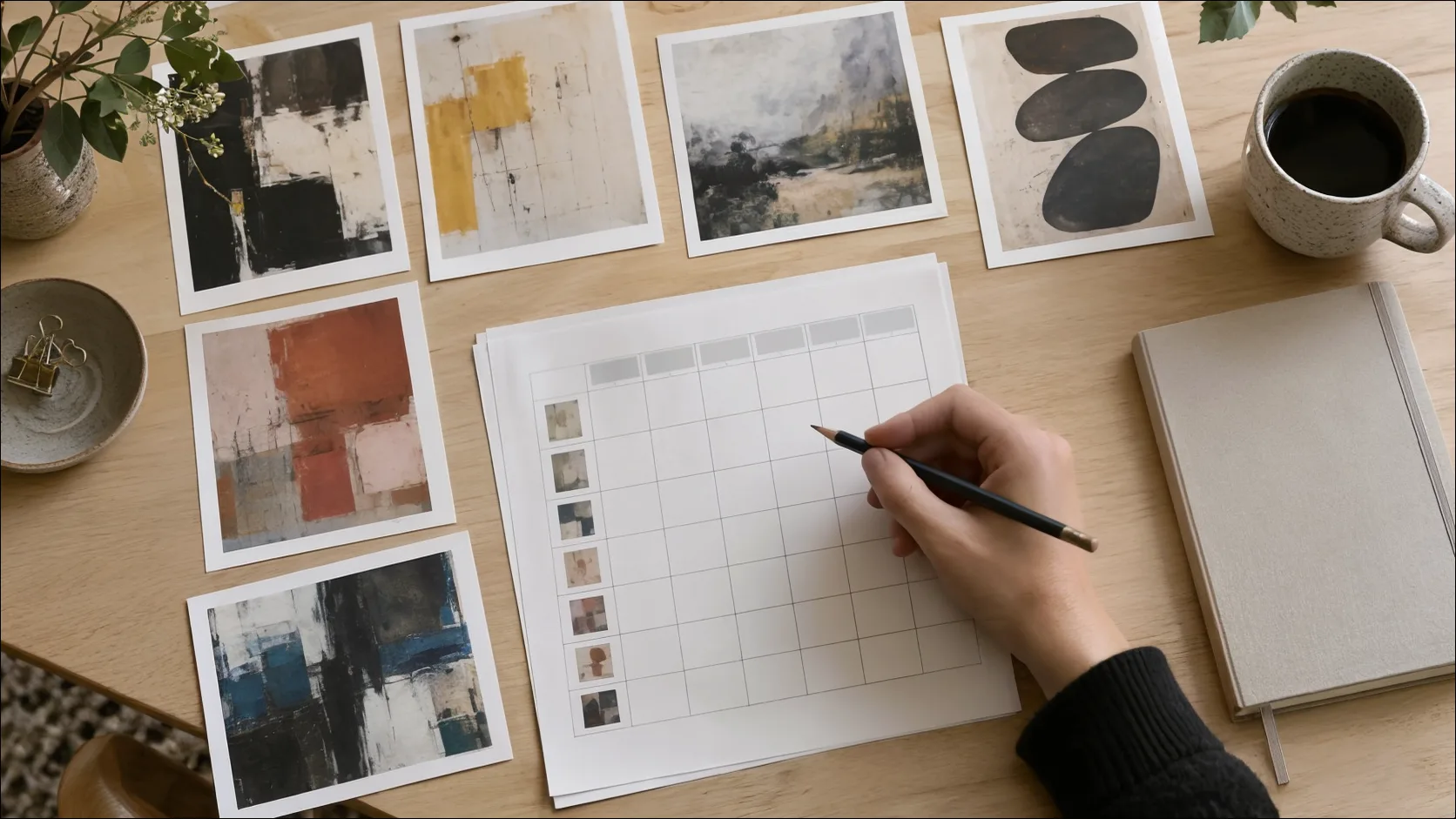
 Limited edition art prints with numbering and edition sizing labels
Selling prints extends the reach of your work and provides income from pieces that already exist. But editions come with their own rules about sizing, numbering, and pricing. Here they are.
One idea underpins all of them: an edition number is a promise. When you write 15/50 on a print you are telling a collector that forty-nine other people can ever own that image and no more, and the price they paid reflects it. Break that promise once and the value of every edition you ever sell is in question. Everything below (how you choose a size, how you number, what you do when demand exceeds the run) comes back to keeping it.
Quick Answer
- Smaller editions (25-50) command higher prices; larger editions (100-500) reach more collectors
- Number prints as sold, not as produced, to maintain flexibility
- Price to cover production costs plus meaningful profit
- Consistency and professional presentation build collector confidence
- Start with one or two images before scaling up
Understanding Edition Types
Limited Editions
A set number of prints produced, after which no more will be made.
Standard limited edition:
- Numbered (e.g., 15/50)
- Signed by the artist
- Certificate of authenticity common
Characteristics:
- Higher price point per print
- Collector confidence in scarcity
- Requires tracking and record-keeping
- Plates/files typically destroyed or archived after edition sells out
Open Editions
Prints available indefinitely with no set limit. They sit at lower price points and serve casual buyers, gift and merchandise markets, and, most usefully, reconnaissance. Running an image open for a season tells you whether anyone wants it before you commit capital to a numbered run of 200. If you are already selling art online, the sales data you have is the best guide you will get to which images deserve a limited edition.
Artist Proofs (A/P)
Prints reserved for the artist outside the main edition.
Traditional practice:
- 10% of edition size (e.g., 5 A/Ps for an edition of 50)
- Originally for testing before final printing
- Now used for gifts, donations, personal retention
Printer's Proofs (P/P)
Proofs given to the printer as compensation or samples.
Hors Commerce (H/C)
Prints marked "not for sale" but identical to edition prints. Used for exhibitions, submissions, or archives.
Choosing Edition Size
Edition size determines both potential revenue and price point.
Edition Size Comparison
| Edition Size | Price Range Typical | Market Position |
|---|---|---|
| 10-25 prints | $500-5,000+ | Gallery/collector market, high exclusivity |
| 50-100 prints | $150-500 | Serious collectors, affordable originals alternative |
| 100-250 prints | $75-200 | Accessible collecting, broader market |
| 250-500 prints | $35-100 | Entry-level collecting, gift market |
| Open edition | $20-75 | Merchandise, casual purchases |
Factors to Consider
Your market:
- Established collectors prefer smaller editions
- Younger/newer collectors often start with larger editions
- Corporate buyers may want multiple prints from larger editions
Your goals. These pull in different directions, so pick one. Maximum revenue usually argues for a larger edition at a lower price. Prestige and gallery relationships argue for a small one, because galleries are wary of artists whose work is available everywhere at every price. Broad exposure argues for volume, on the theory that more walls eventually means more collectors, a calculation that only works if you are willing to do the marketing that comes with it.
Your capacity. A run of 25 fits in a drawer and ships itself. A run of 300 is a fulfillment operation with storage, packing materials, and a customer service inbox attached. Be honest about which business you want to be running in eighteen months.
Image demand:
- Popular images can support larger editions
- Niche work may never sell 500 prints
The Math
Edition of 25 at $500 = $12,500 maximum revenue Edition of 200 at $100 = $20,000 maximum revenue
But selling 200 prints requires more marketing, shipping, and customer service than selling 25.
Numbering Practices
Standard Numbering
Format: Print number / Edition size (e.g., 12/50)
Number as sold, not as printed: This gives you flexibility. If you print 50 but only sell 23, you can close the edition at 23 if needed.
Keep exact records:
- Which numbers sold
- To whom
- Date of sale
- Price paid
Those records are the edition. Lose them and you cannot honestly tell a buyer how many remain, which is the one question every serious print collector asks. Keep them somewhere that is not a single spreadsheet on a single laptop, and keep the buyer's contact details with them. The person who bought 12/50 is the most likely buyer for your next edition, which is where an email list starts paying for itself.
What the Numbers Mean to Collectors
Some collectors believe lower numbers (1/50, 2/50) are more valuable. There is no production-quality reason for this, but the perception exists.
Options:
- Number sequentially as sold (simpler)
- Reserve low numbers for important collectors or higher prices
- Make no distinction and explain this to collectors
Signing Prints
Standard practice:
- Sign in pencil (more archival than ink for some papers)
- Sign in the margin below the image
- Include edition number, date optional
Placement:
- Signature: Lower right
- Edition number: Lower left
- Title (optional): Center
Print Production
Printing Methods
Giclée (inkjet):
- Industry standard for fine art reproduction
- Archival inks and papers available
- Excellent color accuracy
- Cost-effective for small runs
Lithography:
- Traditional printmaking method
- High initial setup cost
- Better for large editions
- Has prestige in collector markets
Screen printing:
- Bold colors, graphic work
- Each color requires separate screen
- Popular for poster market
- Lower cost for simple designs
Risograph:
- Trendy, distinctive look
- Limited color capability
- Growing artist market
- Affordable for short runs
Whichever method you choose, the print can only be as good as the file behind it, and a photograph that looks fine at 1200 pixels on a website can fall apart at 24 inches wide. Reshoot the original properly before you commit to a run; documenting your artwork covers capturing at print resolution with accurate color.
Paper Selection
Paper dramatically affects perception and price.
Archival considerations:
- Cotton rag: Highest quality, acid-free
- Alpha cellulose: Good quality, more affordable
- Coated papers: Better color saturation, less "art paper" feel
Surface options:
- Matte: No glare, traditional fine art look
- Satin/luster: Slight sheen, popular for photography
- Glossy: High saturation, casual/commercial feel
Weight:
- Heavier paper (300+ gsm) feels more substantial
- Standard (200-280 gsm) works for most applications
- Lightweight for posters and casual prints
Quality Control
Before signing:
- Check each print for defects
- Compare colors to reference
- Verify paper is undamaged
- Ensure margins are consistent
Reject prints with:
- Banding or printing artifacts
- Color inconsistency
- Paper damage or marks
- Misalignment
Pricing Your Prints
Cost-Plus Pricing
Calculate all costs, then add margin.
Production costs:
- Printing (per print)
- Paper
- Packaging materials
- Shipping supplies
Overhead allocation:
- Marketing time
- Photography of original
- File preparation
- Storage
Profit margin:
- Industry standard: 50-100% markup over costs
- Higher for smaller editions
- Lower for larger editions and ongoing sales
Market-Based Pricing
Research what similar artists charge, comparing like with like: career stage, edition size, print size, production quality, and whether they are selling into a fine art or a commercial market. An emerging artist pricing against an established one's editions will sit unsold; the reverse leaves money on the table. Print prices should also make sense next to your original work, so settle that relationship first. How to price your artwork covers the underlying formulas.
Price Psychology
Use round numbers. $150 reads as a considered price; $147 reads as a discount store. Show the original's price alongside the print's so buyers have something to measure against. A $200 print looks like access to a $4,000 painting rather than an expensive poster. And offer two or three sizes at different price points, because the decision then becomes which one rather than whether.
Once you set a price, raising it is difficult. Start slightly higher than you think, and offer promotions if needed. Lowering prices devalues work already sold.
Selling Prints
Direct Sales
Selling through your own website or studio.
Advantages:
- Full profit margin
- Direct customer relationships
- Complete control over presentation
Requirements:
- E-commerce setup (selling online guide)
- Fulfillment system
- Customer service capacity
- Marketing effort
Platform Sales
Using established platforms (Etsy, Saatchi Art, Society6, etc.).
Advantages:
- Built-in audience
- Handled payment processing
- Some handle printing/fulfillment
Disadvantages:
- Platform fees (15-50%)
- Less control over presentation
- Competition within platform
- May affect gallery relationships
Gallery Representation
Galleries take 40-50%, handle the selling and occasionally the production, and will almost always insist the edition be limited. Most will also require that your prices stay consistent across every channel you sell through, which is worth knowing before you discount on your own site. Get the terms in writing; artist contracts and legal basics covers what a print consignment agreement should say.
Corporate and Bulk Sales
Offices, hotels, and healthcare buyers work differently from collectors. Larger or open editions suit them better, per-unit prices are lower and volumes higher, and you may be asked to produce at sizes you do not normally offer. Expect net-30 or net-60 payment terms and budget accordingly. Much of this business arrives through intermediaries rather than directly; see working with art consultants.
Managing Your Print Business
Record Keeping
Track for each edition:
- Image title and edition size
- Numbers sold and to whom
- Numbers remaining
- Price history
- Location of plates/files
Inventory Management
Print on demand vs. print in advance:
- On demand: No inventory cost, slower fulfillment
- In advance: Faster shipping, upfront investment, storage needs
Storage:
- Flat storage in acid-free materials
- Climate controlled if possible
- Organized for quick retrieval
Shipping
Rigid mailers for small prints, tubes for large ones, crates for anything valuable enough that a courier dropping it would be a real loss. Insure every shipment at full value, require a signature on expensive prints, and photograph the packing before it goes out, because carriers deny damage claims routinely, and the photograph is what settles them. Shipping artwork safely covers materials and carriers in detail, and framing artwork is worth reading before you offer framed prints, since framed shipping is a different problem entirely.
Common Mistakes
Editions too large: Printing 500 when you have never sold 50 prints ties up capital and creates storage problems.
Editions too small: Printing 10 when demand exists for 100 leaves money on the table.
Inconsistent numbering: Losing track of which numbers sold creates credibility problems.
Poor production quality: Cheap printing undermines your work and reputation.
No marketing: Prints do not sell themselves. Budget time and money for promotion. Social media gives you reach, and a print table at an art fair or your own pop-up show is where the sales actually close in person.
Undercutting originals: If prints are too cheap relative to original work, it can devalue both.
Frequently Asked Questions
Should I sell prints of work I am also selling as originals?
Yes, this is common practice. Price prints well below originals (typically 5-20% of original price). Some collectors want originals; some want prints. They are different markets. Selling prints can increase awareness that leads to original sales.
What if I want to change the edition size after starting?
You can close an edition early (print fewer than announced) but never print more than announced. If you advertised 50 prints and sold 30, you can close the edition at 30. But if you said 50, you cannot print 75. This is why numbering as sold gives flexibility.
Should I destroy the plates or files after an edition sells out?
Traditional practice is to destroy plates or mark files as closed. Some artists provide certificates stating the edition is complete. The key is that you honor the edition limit. Whether you formally destroy files is your choice, but never reprint a closed edition.
How do I price prints of different sizes?
Larger prints should cost more due to production costs and perceived value. A common approach: set your anchor price for your most popular size, then price other sizes relative to that. Double the dimensions does not mean double the price, but there should be meaningful difference.
Should I offer framed prints?
Framed prints have higher price points but require more inventory and shipping complexity. Some artists partner with framers. Others offer framing as an add-on. Unframed prints are easier to start with; add framing once you have systems in place.
What about print-on-demand services?
Print-on-demand (Society6, Redbubble, etc.) removes production complexity but typically means lower quality and profit margins. Good for open editions and merchandise. For serious limited editions, control your production directly or work with a fine art printer.
Ready to Start Selling Prints?
Selling prints works best when you already have an audience, because a print is a purchase people make from artists they have been following rather than artists they have just found. An online presence is what makes that following possible: somewhere collectors can see the whole body of work, check what is still available, and reach you.
Create your free Artsume profile to showcase your work and build your collector base. Artsume's portfolio gives you one link to send collectors, and sharing your profile covers getting it in front of them.
Related Guides: