From the community
Chimemelie Okafor: Painting Time, Layer by Layer
The Toronto-based Nigerian artist on the textiles that shaped her visual language, researching Igbo understandings of time, and finding her voice through painting.
Interview by David Rozenfeld
· 11 min read
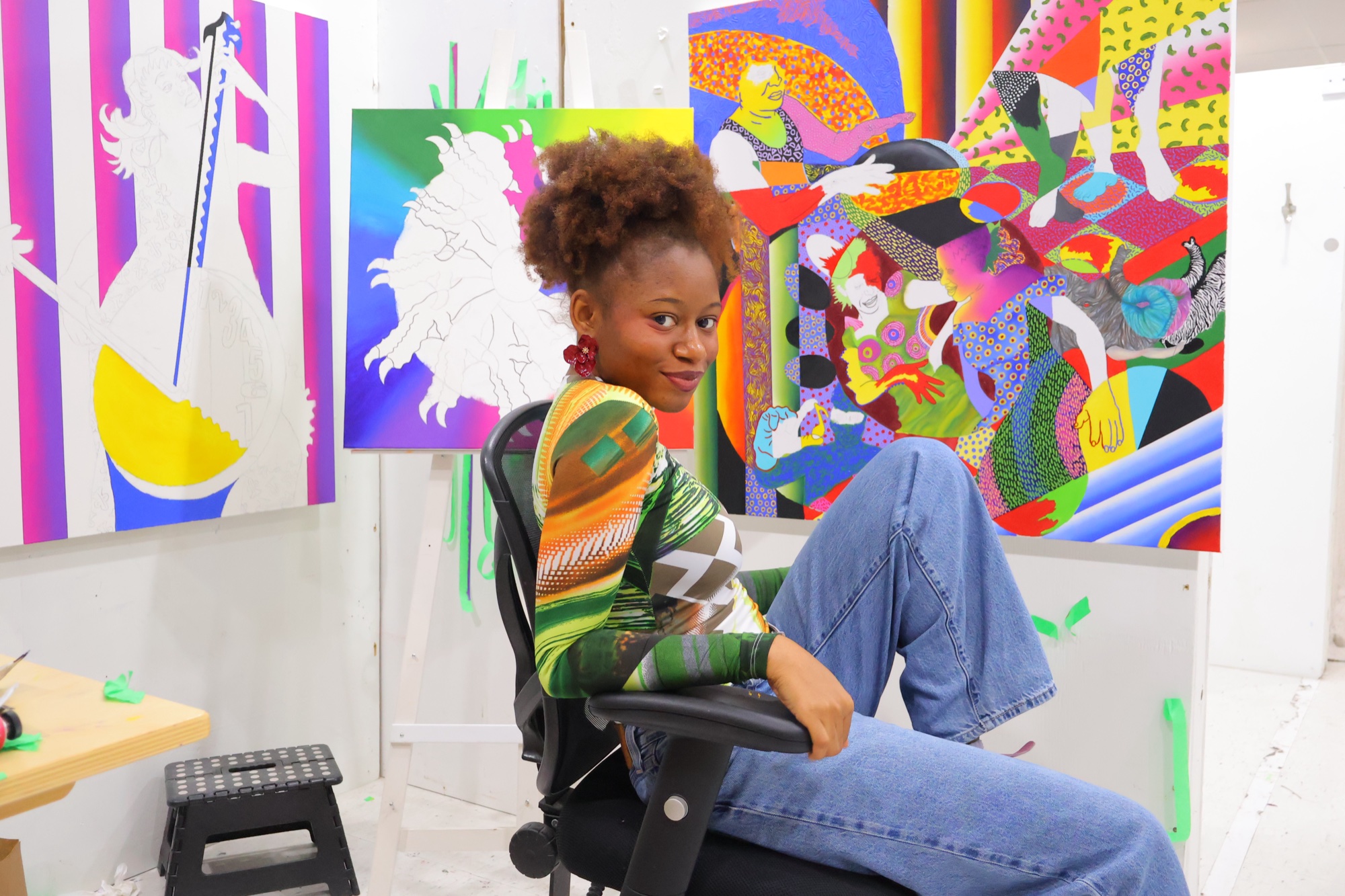
Growing up in Nigeria, Chimemelie Okafor wore fabrics her mother chose for church, weddings, and family gatherings. Sometimes she and her siblings needed convincing. Years later, those textiles have become an important influence on her paintings.
Working primarily in oils, Okafor builds detailed compositions through successive layers of colour and pattern. Her process draws on her experience with tie-dye and batik, while the figures, gestures, and stories within the paintings explore her identity and, increasingly, her culture.
A recent graduate of OCAD University’s Drawing and Painting program, she has been researching Igbo understandings of time. That inquiry became a four-painting thesis installation moving through pre-colonial timekeeping, colonial disruption, resistance, and the reclamation of cultural knowledge.
In this Artsume community conversation, we spoke with Chimemelie about the family influences behind her work, the process that takes an image from a dream to an iPad to a canvas, and the questions she is carrying into her next paintings.
This interview has been edited and condensed for clarity.
The fabrics she grew up wearing
How would you introduce yourself and the work you make?
I’m a Nigerian multidisciplinary artist and designer. My work is inspired by the material and process-based qualities of West African textiles I grew up wearing. I try to turn those qualities into my own visual language.
The themes in my work centre around the human experience, but recently I’ve been working more with my culture and issues in my country.
What do you remember about those textiles growing up?
My mum would buy fabric and have dresses made for us to wear to church, family gatherings, or someone’s wedding. Sometimes she would make me and my siblings wear them even when we didn’t really want to.
Growing up wearing those textiles, I wanted to bring their look and feel into my painting practice.
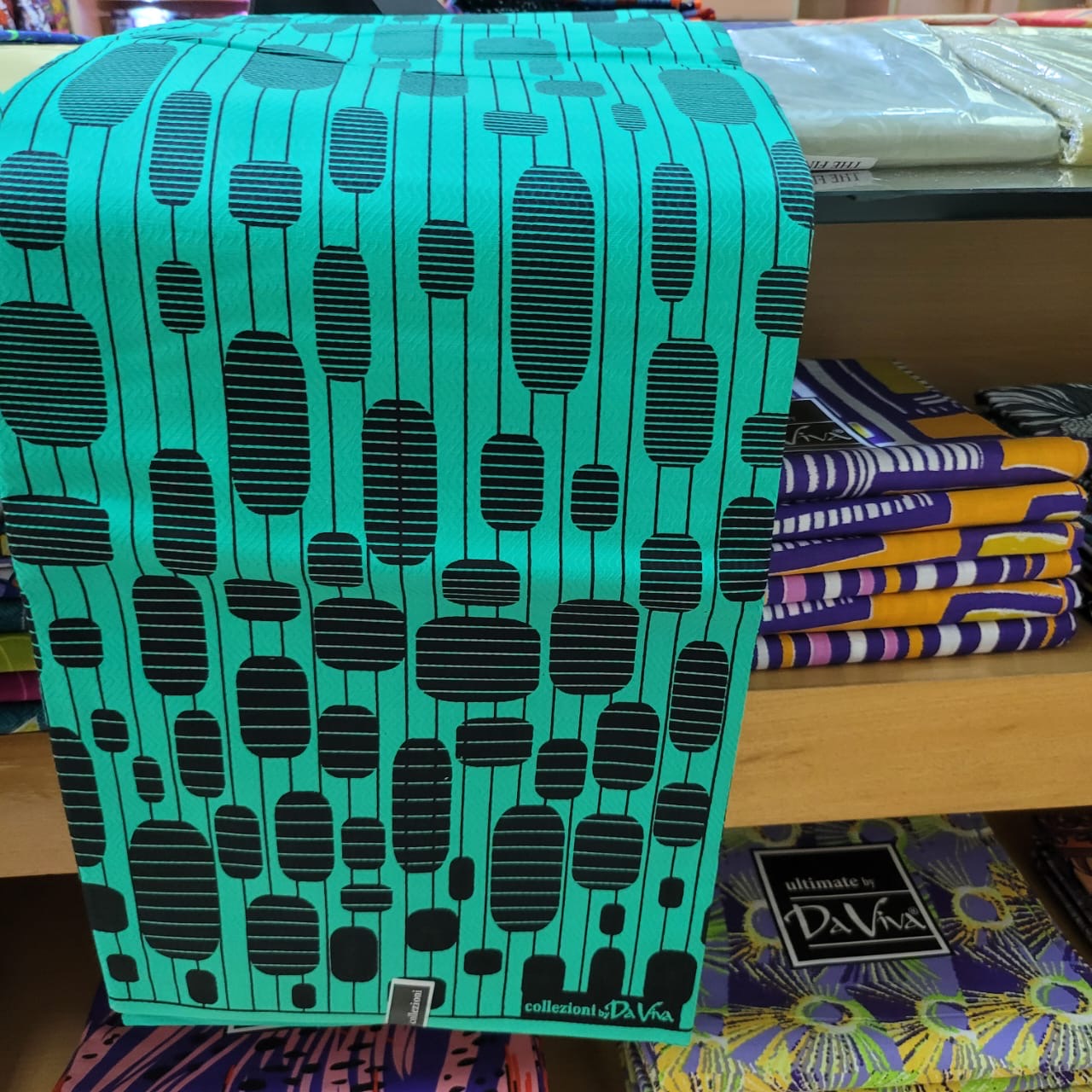
Being in Canada now, sometimes I’m even shy about wearing my cultural clothing. Back in Nigeria, it was something my mum made sure we wore.

Was art encouraged in your family?
My dad is very artistically inclined, although he isn’t an artist.
When we had art projects in primary school, he would take the time to help us. He would try to make sure we did the work ourselves, but he would also bring his own artistic ideas into it.
He took me to art shops to buy paint. He would notice if I hadn’t been drawing and say, “You paint a lot, but I haven’t seen you draw in a while.”
My parents were supportive when art was a hobby, before I told them I wanted to pursue it as a career. That encouragement helped.
Finding a visual language
When did you begin recognizing the style you work in now?
Looking back at my portfolio, I think BIG GIRL DILEMMA was where you could really see the beginning of the patterns and the style.
I don’t remember exactly why I decided to start working that way. I jumped in one day, and it kept evolving. With each painting, I try to evolve from what I’ve just made.
That piece also felt different because of how intentional I was. It was the first time I tried pointillism, and it took a lot of time. Previously, I might have finished something in three, four, or five days. With this one, I stayed up working on every detail.
I wanted someone to see it and understand that it took time to make.
30 x 24 inches
A figure whispers to another figure. The text "MAKE IT STOP' is written on the side. This painting portrays the woman’s perspective on the passage of time and how our life changes after getting our first period. The constant body changes…
How does your experience with textiles shape the painting process itself?
In secondary school in Nigeria, I had experience with tie-dye. I try to replicate aspects of that process in my painting.
With tie-dye or batik, you might tie the fabric, dye it, let it dry, and then make another design and dye it again.
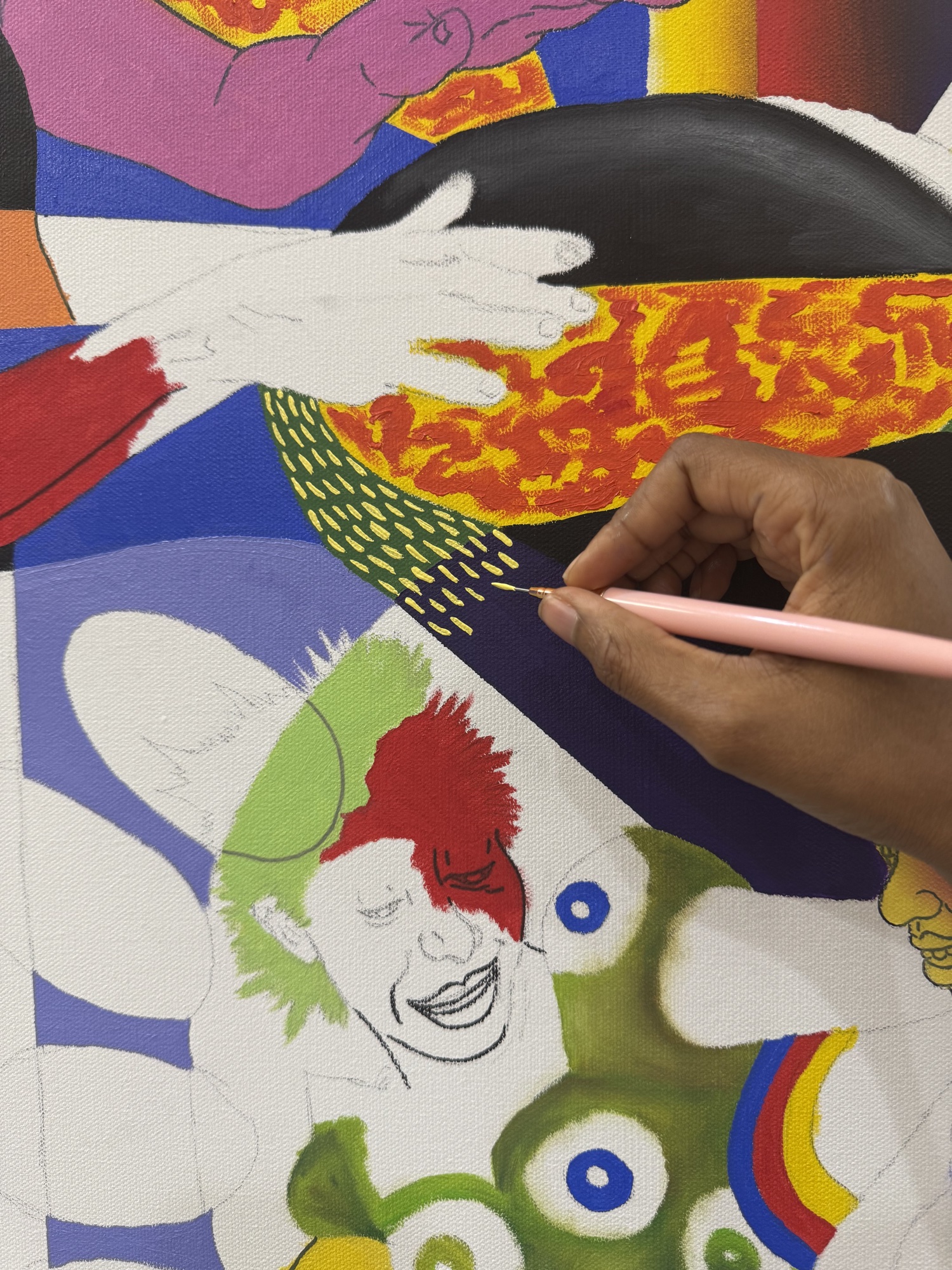
It’s similar with my paintings, especially because oil paint takes time to dry. I’ll put down a base colour, wait for it to dry, add a pattern, wait again, and then add another layer.
Those different layers make the overall composition more complex.
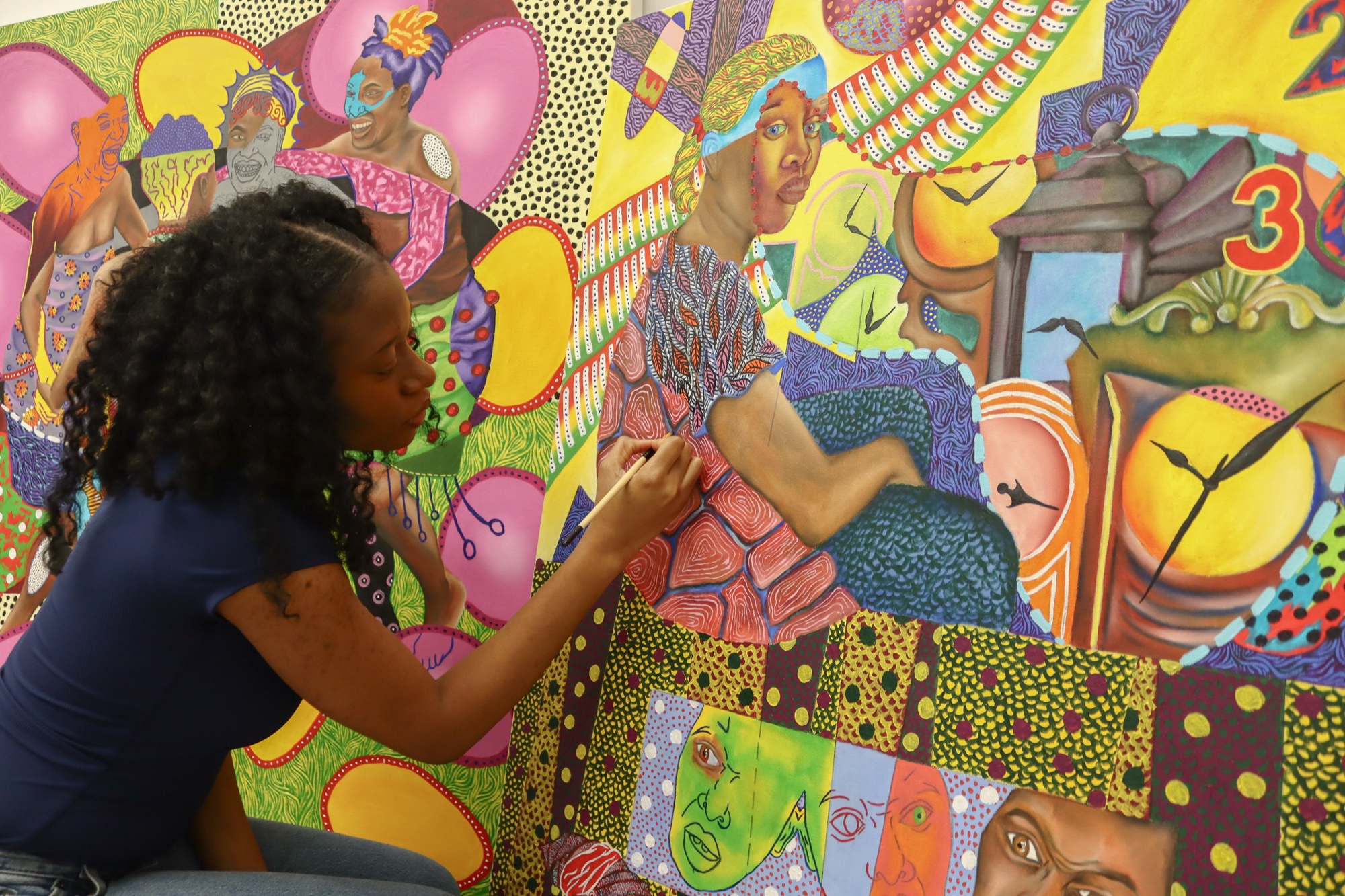
Your face and body appear throughout your work. What draws you to painting yourself?
My paintings began with me painting about myself: my identity, being shy, and those aspects of who I am.
Even when I paint about my culture, it’s still part of my identity. I’m still speaking about myself.
As a woman, I also want someone to see my work and see themselves within me. That representation matters.
The painting that opened another direction
You’ve said your work wasn’t always focused on Nigeria. What changed?
At OCAD, we had an assignment about painting an issue. There was a lot of corruption going on in my country, and I thought, “Why don’t I paint about my country for the first time?”
That became To Defend her Unity?
The leader is placed inside a television box, eating from a bowl. It represents the government consuming the people’s resources, while the people at the sides look on.
After making that painting, I became interested in researching more about my culture. One thing led to another.
Painting about it also helps me learn more about it.
There’s a gold watch attached to that canvas. How did it become part of the work?
I also make jewellery using watches, and I was experimenting with how to bring my jewellery and painting practices together.
In the original sketch, that part was a ring. I thought I could try incorporating the watch into the painting, almost as a form of collage.
It also represents time ticking.
Oil paint and gold watch on canvas · 30 x 48 inches
Man eats out of a bowl as figures watch. This painting sheds light on the corrupt practices currently happening in Nigeria and how those in power take resources meant for the people and use them for their own gain.
Researching Igbo understandings of time
How did time become the subject of your thesis?
Because I work with watches in my jewellery, I thought time could be a way of bringing the two practices together.
My initial idea was to imagine myself as a time traveller, going back to cultural practices I wanted to learn more about. I grew up in the city rather than my parents’ hometown, so there were things I hadn’t experienced.
Then I came across an article about the Igbo concept of time. That led me into researching a different way of understanding and organizing time.
I’m still researching it. There’s a lot I don’t know yet, and it’s something I want to keep exploring in future work.
What did that research add to what you already knew about your culture?
It isn’t that I didn’t know my culture. My parents made sure they taught us what they knew. Even though I don’t speak the language fluently, I can understand it.
What I’m learning about now are parts of the culture that have been displaced, or that fewer people know about. In my experience of education in Nigeria, Western knowledge was prioritized.
I asked my parents what they knew and then did my own research. Sometimes I would go back to my mum with something I’d found, and she would say, “I didn’t even know about that.”
So she was learning something new, too.
Our experiences and the information we learn shape our identities. Learning about the people who came before us is part of understanding who we are.
Four paintings, one unfolding story
Could you walk us through the four paintings in your thesis installation?
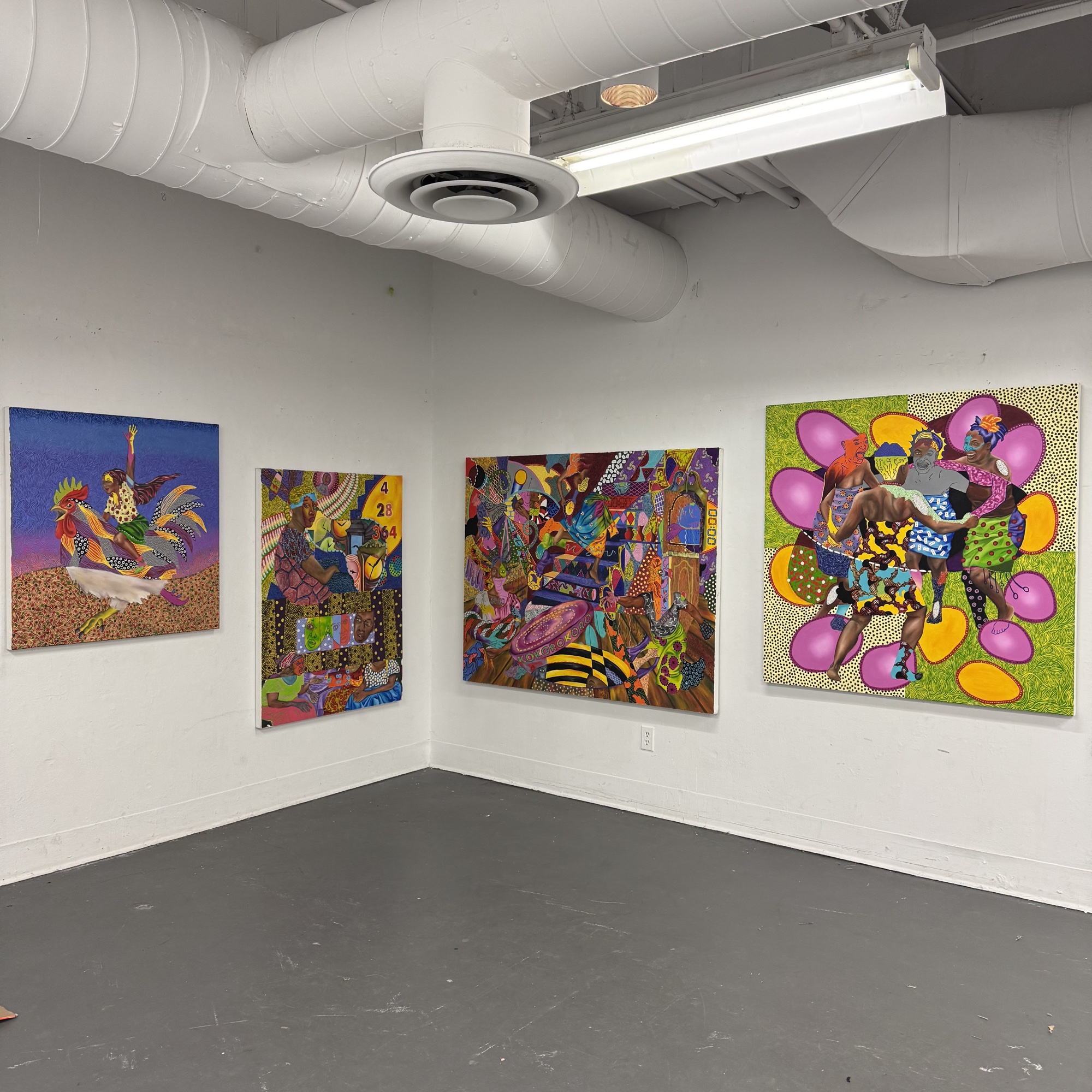
The first is When the Cock Crows. It honours the chicken as an alarm clock.
You can see me riding on the chicken, encouraging it to wake us in the morning. I wanted to emphasize its importance in daily life, something that can be overlooked.
36 x 36 inches
Figure riding on a large chicken at sunrise. This painting portrays how Igbo people understood time through natural occurrences such as the crowing of a rooster. Before mechanical clocks, the rooster indicated when to wake up and begin…
The second painting, he has won our BROTHERS and our CLAN can no longer act as one, addresses colonial disruption.
The women represent the four market days. Clocks sit above them, and the women are divided and arguing. I wanted to show the impact of colonialism on our systems of knowledge.
48 x 36 inches
A collection of clocks placed above four figures in disagreement with a bigger figure looking towards the viewer. This painting reflects the disruption caused by colonial systems of timekeeping. The four market days, Eke, Orie, Afor, and…
Then comes Things Fall Apart, which I made as a form of resistance.
It’s the most complex painting in the series. There are figures running, hiding, and throwing. I didn’t want to show people literally fighting, so I used gestures that could suggest actions during a war.
The chicken appears against a digital time display marking the start of a new day. Both are connected to the beginning of the day, but in different ways.
48 x 60 inches
An action scene between the chicken and the clock. The painting spotlights reclaiming original ways of knowing through decolonization. The composition presents two opposing forces, the chicken, representing natural timekeepers, and the…
The final painting is Spiralic Temporality. The four market days appear as women in a round dance.
Through my research, I became interested in circular and spiralic understandings of time. The dance represents returning to knowledge that had been lost or displaced. The circles and spirals also refer to the thirteen months I was researching.
48 x 48 inches
Four women doing a round dance This painting imagines a vision of renewed cultural sovereignty, The four market days are portrayed as women performing a round dance, moving together in balance. Curved linework, circles, and polka dots…
What would you invite someone to spend longer looking at in Spiralic Temporality?
The woman’s back, and her legs.
I took a long time painting that skin. At first, I didn’t like it, but then a friend pointed out how convincing the back looked.
I sometimes struggle with painting skin, so I really took my time with it. And the patterns on the fabric are important, too.
From an idea to the canvas
How does a painting develop in the studio?
I begin with research, then think about how to show what I’ve learned metaphorically.
Sometimes I see ideas in dreams, almost like visions. I write them down and start turning them into images.
I think about gestures, pose them myself, and work with those images on my iPad. I like laying out the details digitally because it’s easier to change something or erase a mistake there than in oil paint.
Then I transfer the composition to the canvas.
Sometimes it changes once I’m painting. I might improvise on the canvas, then take that change back into the digital version to see how it works.
I basically do double the work.
Why do you keep choosing oil paint, even with all that drying time between layers?
I love how it flows and how vibrant it is. I find it easier to work with than acrylic.
I’ve had professors tell me acrylic would suit my process because I could produce more work. But I still prefer oil, even though it’s time-consuming.
Before painting, I drew. I still like drawing the composition and bringing it together before adding colour.
A collage class in my second year at OCAD also influenced my style. I love bringing different elements together into one composition. Sometimes I make collages in my free time just because I enjoy that process.
Carrying the work forward
What are you figuring out now that you’ve finished your degree?
OCAD helped me find my visual language.
It’s still evolving, and I want to keep improving, but I have a clearer sense of the paintings I want to make. Now I want to build a more robust body of work and put myself out there.
I’m extremely shy, so that also means putting myself in situations I wouldn’t normally choose and applying for opportunities.
What questions are you exploring in your newer paintings?
I’m still exploring time, but I’m also thinking about how difficult it would be to return to earlier ways of understanding it.
How do I bring Igbo concepts of time and Western time together in the work?
In one painting I’m working on, there are twelve chicken feet arranged as a clock. I’m trying to imagine what that meeting of the two systems could look like.
It’s something I’m still working through.
How did you find Artsume, and what has your experience been?
I think I was applying for something, and it led me to Artsume. I uploaded my portfolio and images.
I check the opportunities, and I’ve also been able to connect with people and discover artists.
I’ll see someone’s work in the feed, think it looks interesting, and go to their profile. It helps me find people whose work I can be inspired by.
Explore Chimemelie Okafor’s work and connect with her on Artsume.