In conversation · Daniela Savarese
Daniela Savarese: Painting the People We Can Never Fully Know
On the emotional weight of quiet moments, a friendship spanning 25 years, and building a career without losing the pleasure of painting.
Interview by David Rozenfeld
· 12 min read
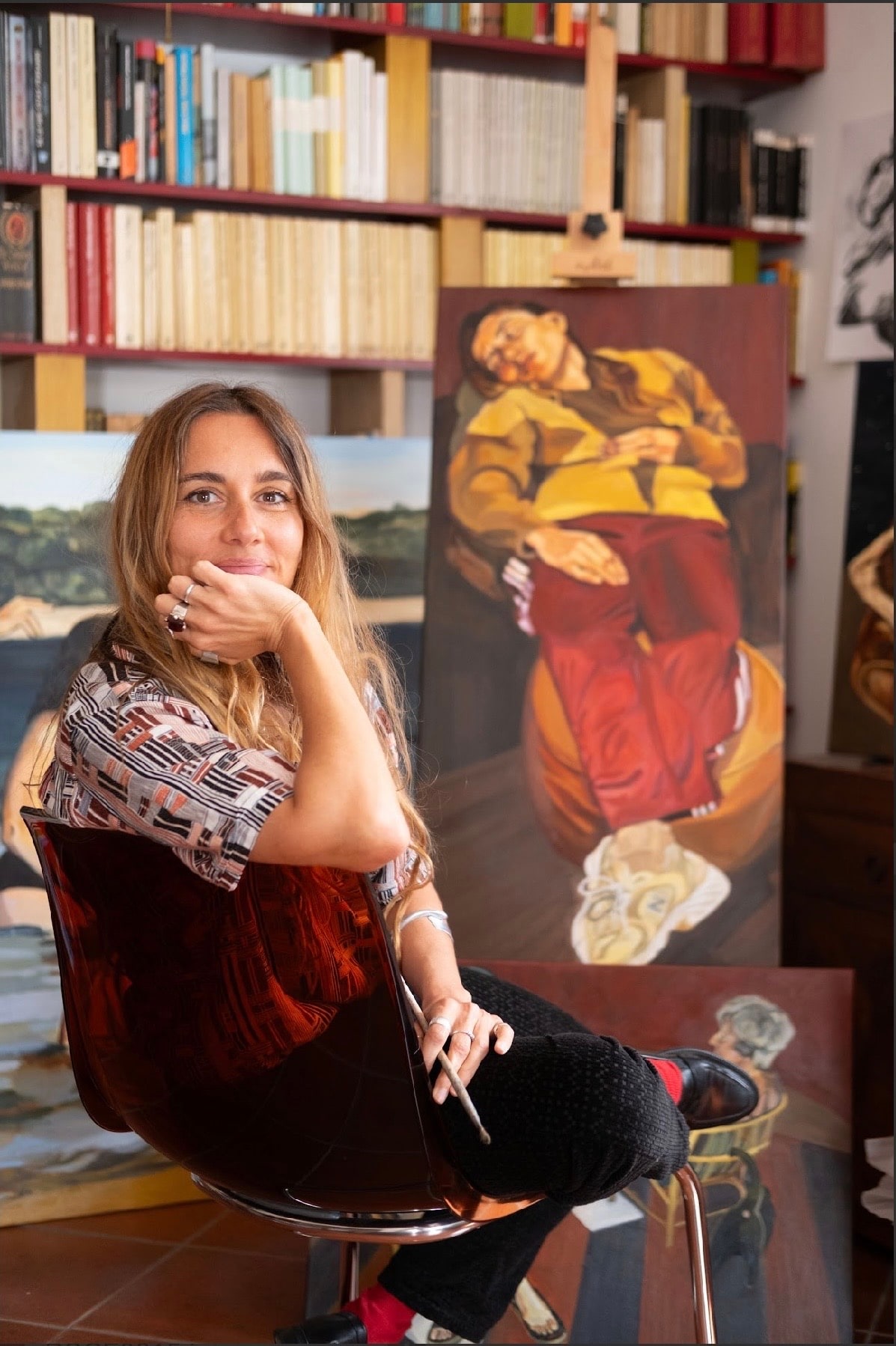
A person can be deeply familiar and still, in some ways, unknowable. For Daniela Savarese, that tension is part of what makes them worth painting.
Living between Portugal and Germany, Daniela returns often to the people closest to her. Her friend Paola, whom she has known for around 25 years, appears throughout her paintings. Quiet evenings become charcoal drawings. A figure stretched across a sofa holds not only a particular moment, but a wish for what might come next.
Her interest is less in dramatic action than in what becomes perceptible when someone is still. These are paintings about looking closely and recognizing that even the people we know best have parts of themselves we cannot fully reach.
In this Artsume community conversation, we spoke with Daniela about learning to observe as a child, the relationships behind her work, and finding a way to keep painting that remains meaningful to her.
This interview has been edited and condensed for clarity.
Learning to observe
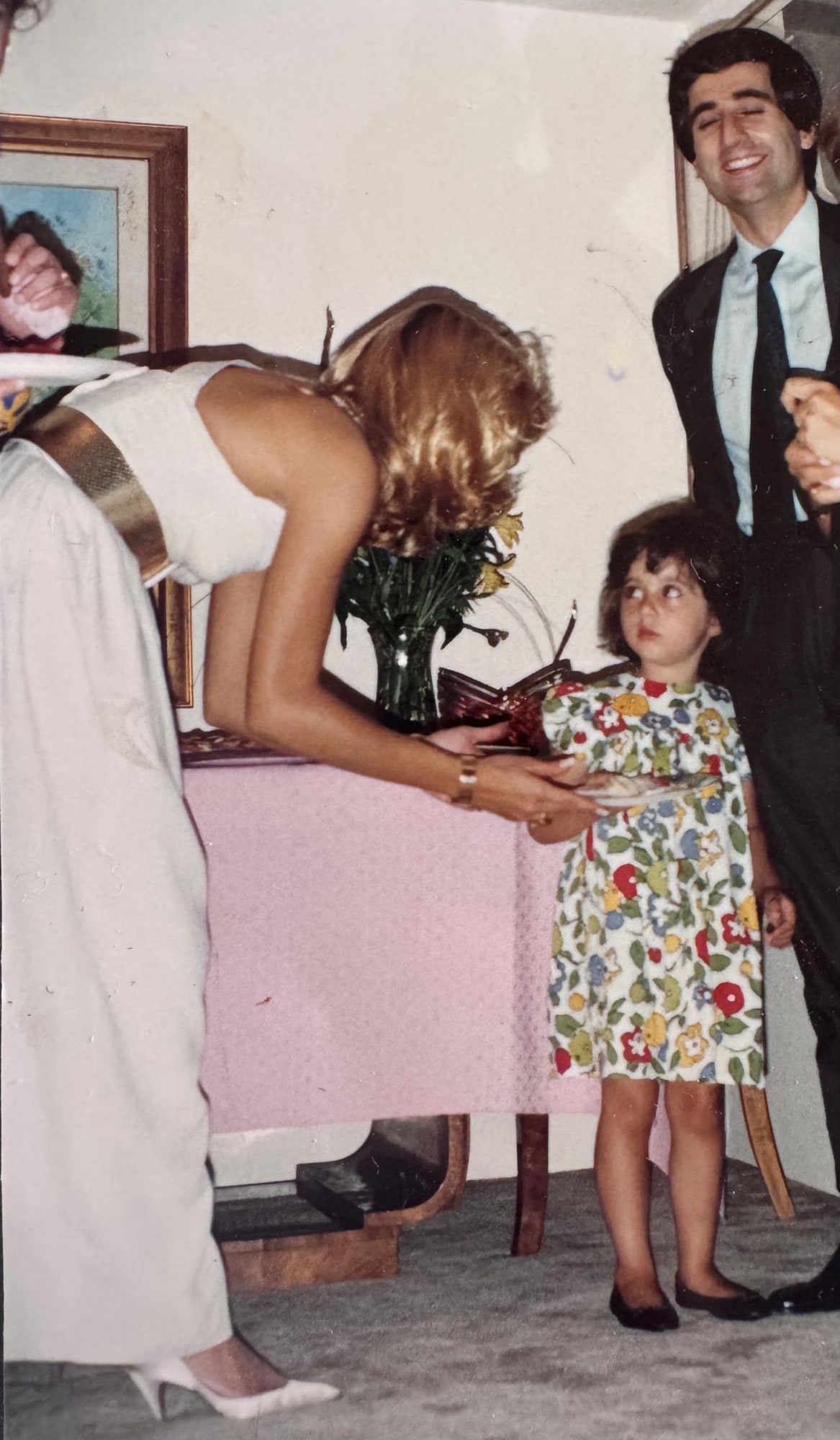
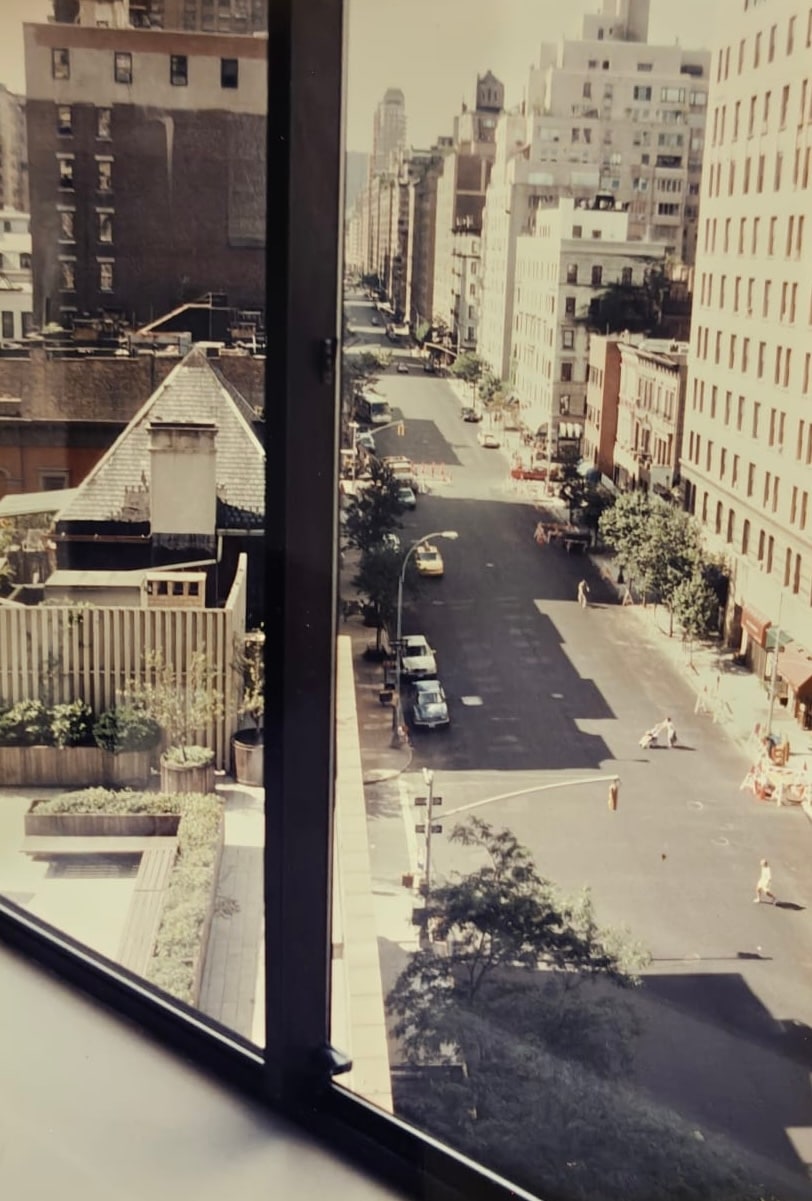
You spent part of your childhood in New York, accompanying your parents to dinners and openings. What do you remember about being the quiet observer in those rooms?
I spent a lot of time surrounded by adults. My parents had a very mixed circle—models, businesspeople, actors—and I remember having a wonderful time.
But as a child, you’re not really part of those conversations unless someone addresses you. For much of the evening, you’re trying to figure out what’s happening around you.
I was quite quiet and well behaved. I remember not understanding what people were talking about—how could I? I was a child. But you still find a way to make sense of your surroundings. You look at their expressions. What do they mean? Are they angry?
You feel your way around the room. I think that never really left me.
When did painting become something you wanted to pursue professionally?
Even now, I still think of myself as somebody making things. It’s my profession, but a lot of the process is about pleasing myself.
Some time ago, I was working during the day and painting in my spare time, and I couldn’t sustain the two anymore. Painting felt so much more meaningful. I couldn’t engage with anything else in quite the same way.
I thought, wouldn’t it be great if I could just do this? It felt like a need, and I wanted to really try.
You can always look for external recognition to tell you whether you’re an artist, but I think it’s always a leap.
The familiar and the unknowable
You’ve lived in different places throughout your life. What has given you a sense of continuity?
There are parts of myself that I always recognize, whether I want to or not. And there are a few people.
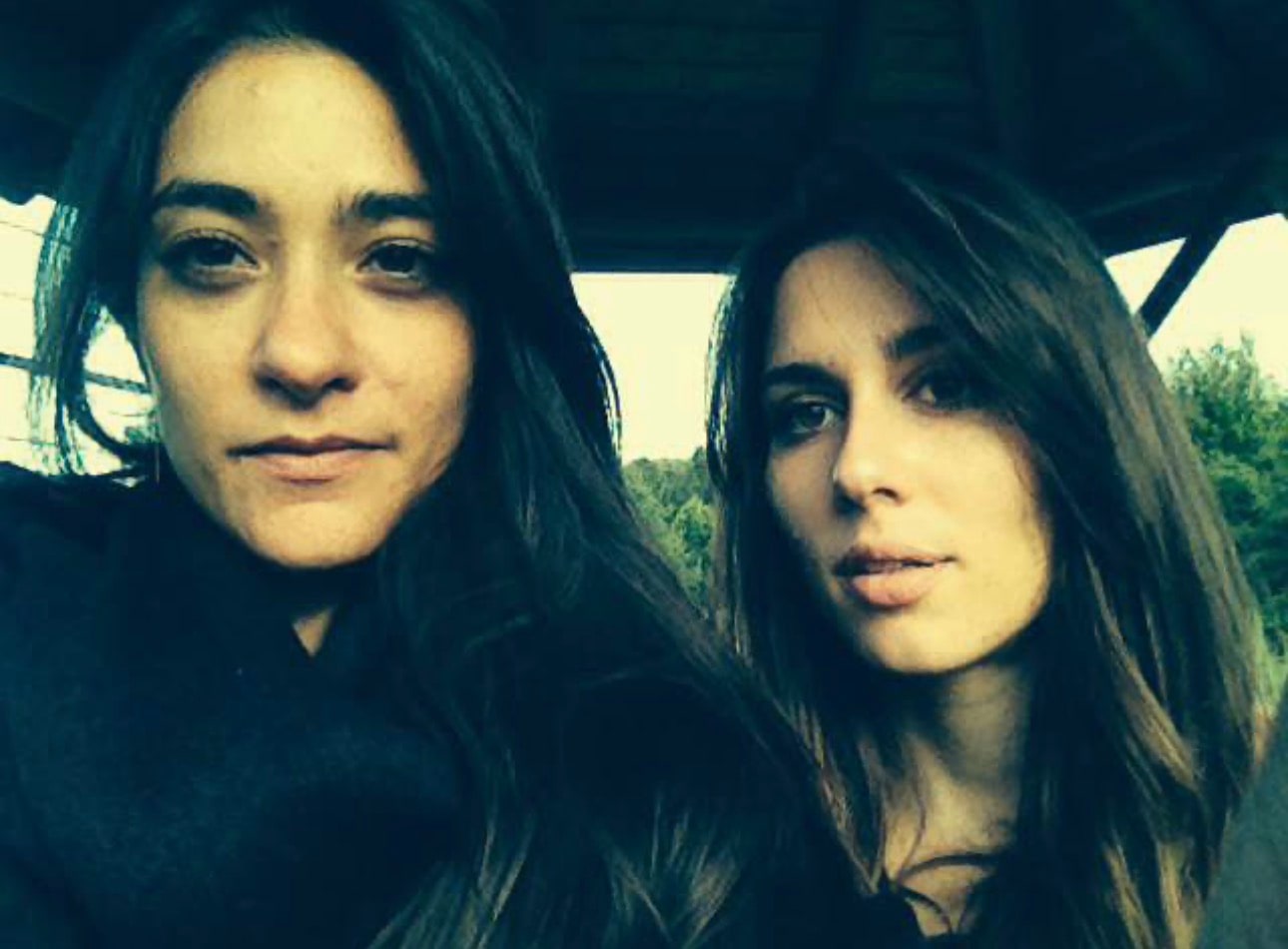
One of them is the friend who appears in so many of my paintings. I’ve known her for about 25 years. We went to the same schools, lived on the same street, and we talk every day.
She’s stayed. I would say she’s the most constant thing in my life.
You’ve spoken about finding emotional depth in physical stillness. What draws you to those quiet moments?
I’m not very drawn to narrative action. There’s something too explicit about it for me. Big movements or expressions can distract me from what I’m looking for.
The quiet moment is where I can most sense what interests me.
How do you decide who you want to paint?
It’s very instinctive. When I see a face, I know. It doesn’t necessarily have anything to do with how attractive or interesting someone is. There’s just something there, and I follow it.
There have been times when I’ve approached strangers in the street, shown them my work, and asked whether I could paint them. People are often willing, and I’ll take a photograph.
Now I’m exploring people I know more often, because it feels more layered. I project a lot of myself, and I get a lot from them.
Absolute accuracy isn’t my goal. There’s going to be a bit of me in the portrait. It has a lot to do with how I see someone.
In Paul in Chair, what were you exploring about a person you know so well?
I had realized that there are things about her that are unknowable—and things about me, probably. That’s true in every relationship.
You think you know somebody so well, and then there are these corners you can’t access. Sometimes they can’t access them either. There’s so much unknown.
There were times when I wasn’t comfortable with that, and times when I appreciated it. I thought it was such a massive part of what a relationship is.
You also have to be respectful of that space. Depending on where you are in your life, you may or may not succeed at doing that.
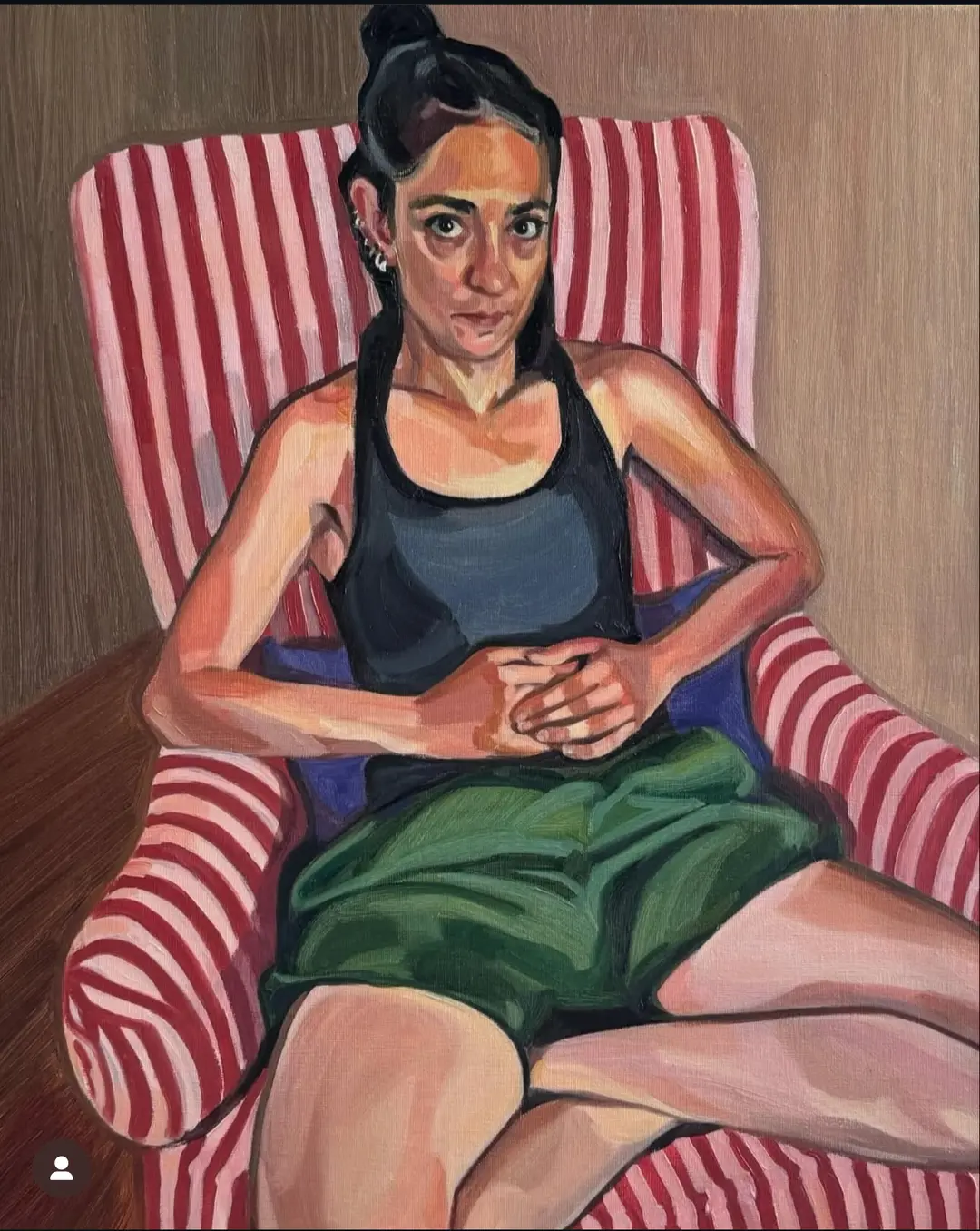
The woman in the portrait is Paola, my closest friend for over 25 years. We grew up together. We are the keepers of each other’s memories and the witnesses to each other’s stories. Even with this depth of connection, there are corners of…
In Space to Cross, your friend stretches across a sofa with her arms overhead. How did that painting begin?
We were on holiday together in the south of Italy. It was a really hot summer, so we spent a lot of time indoors, even though we were on a beach holiday.
She was on the couch, and we were talking and talking. I sketched her.
The painting refers to a particular moment in her life. I was wishing so much for her to be able to do what she wanted to do, and to get past what she wanted to get past.
I imagined her floating, thinking about what she could do—all the possibilities.
That painting is really my wish for her.
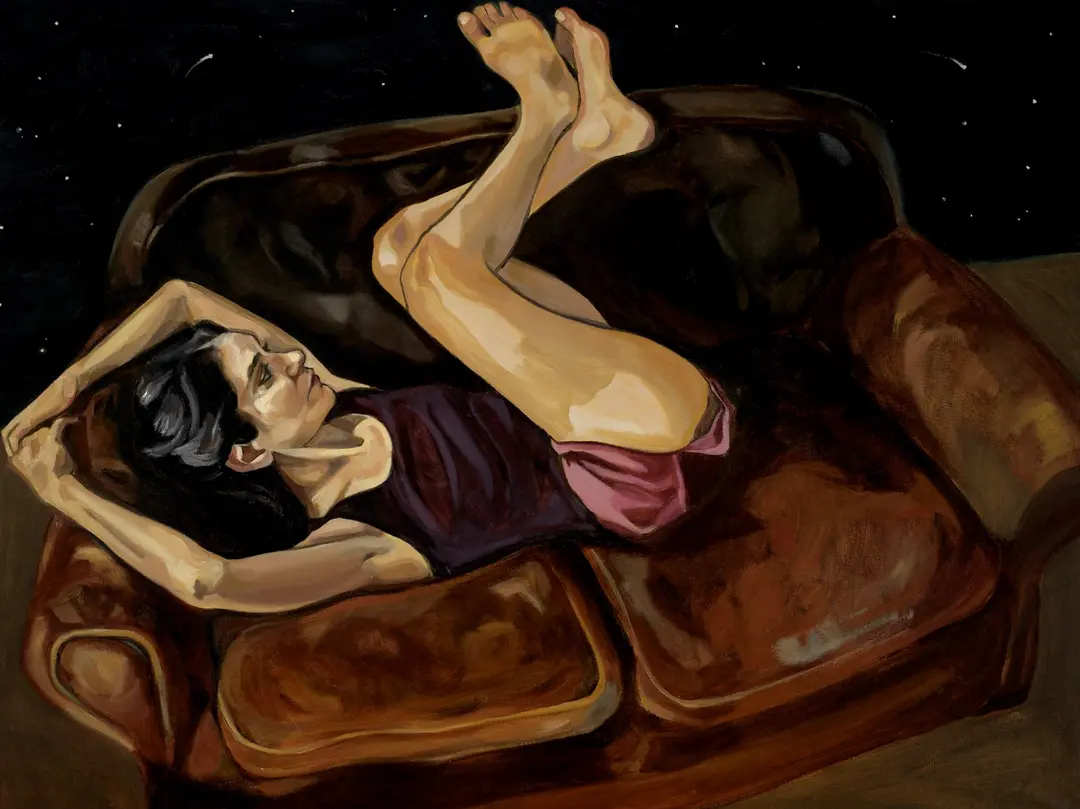
Oil on canvas
In this piece I intended to represent my sitter pondering—floating alone in a space of possibilities and choices, her ideas marinating and developing into something out anyone’s control but her own.
Your painting Isa holds a very different kind of quiet moment. What did you want to capture there?
I would see her quite often, and I saw her decline. This was one of the times we were all together at her house.
I find that people around someone who is ageing can become accustomed to them losing vitality or health. There’s a matter-of-factness that develops. It’s not that people become cold, exactly, but they get used to it.
I wanted to juxtapose that with the leisurely pose—the feet of a healthy young person who is simply watching what’s happening.
There’s something cruel about it, although cruelty isn’t quite the right word. It’s almost an inevitable cruelty. That’s what was going on in the painting.
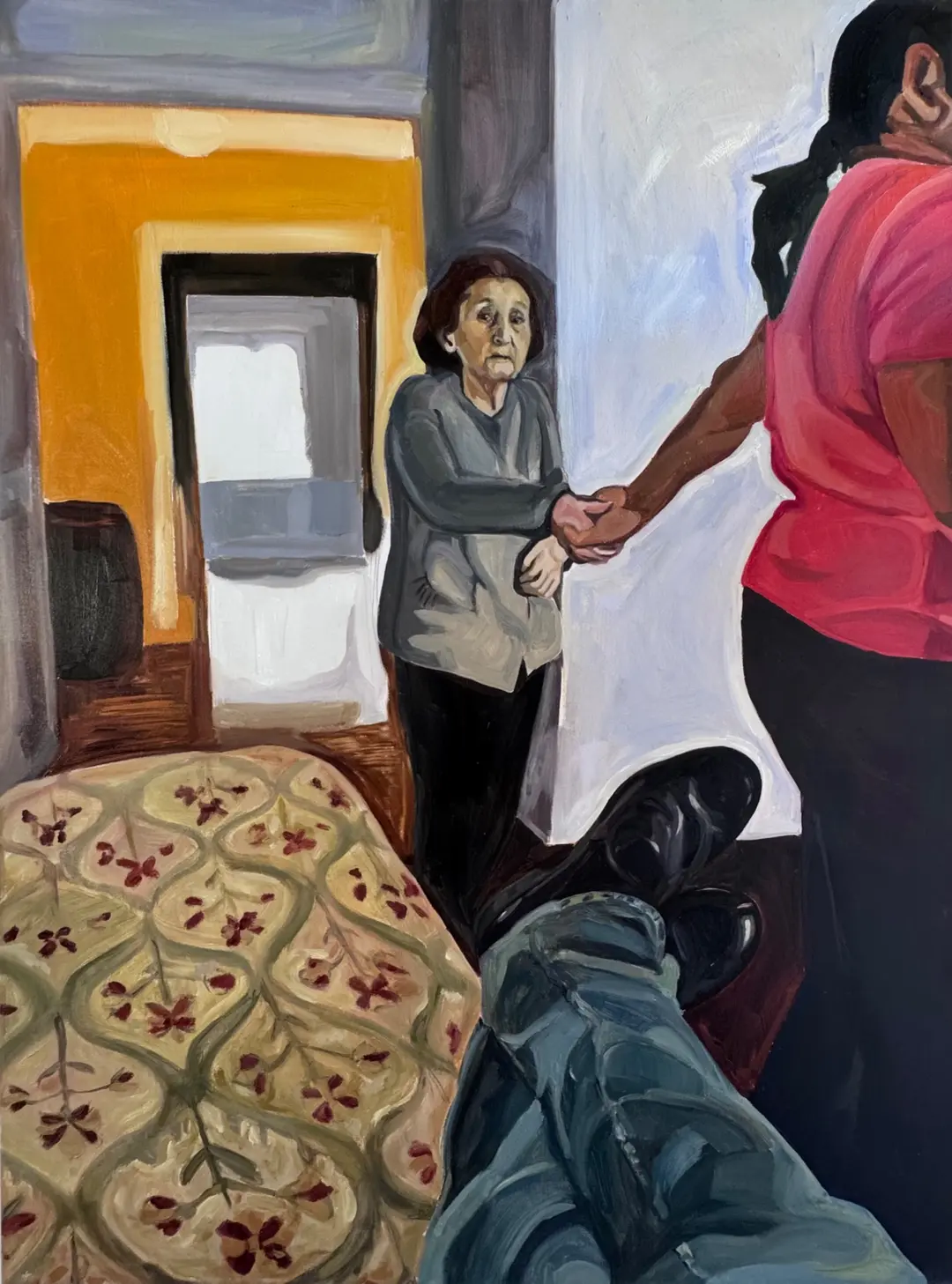
My grandmother, Isa is being led by her caretaker, shuffling her feet across the dining room. She had a small frame, which became even smaller with age. I shrunk it further. I liked the idea that one has to get closer to see her—that…
Keeping the work alive
Your charcoal series Blue Hour Song brings together intimate, everyday scenes. What connects those drawings?
Drawing is a completely different experience from painting. I use it to take a break.
When I paint, I have to be in control and consider technical things, like drying times. Drawing is much freer for me. I need both to balance each other out.
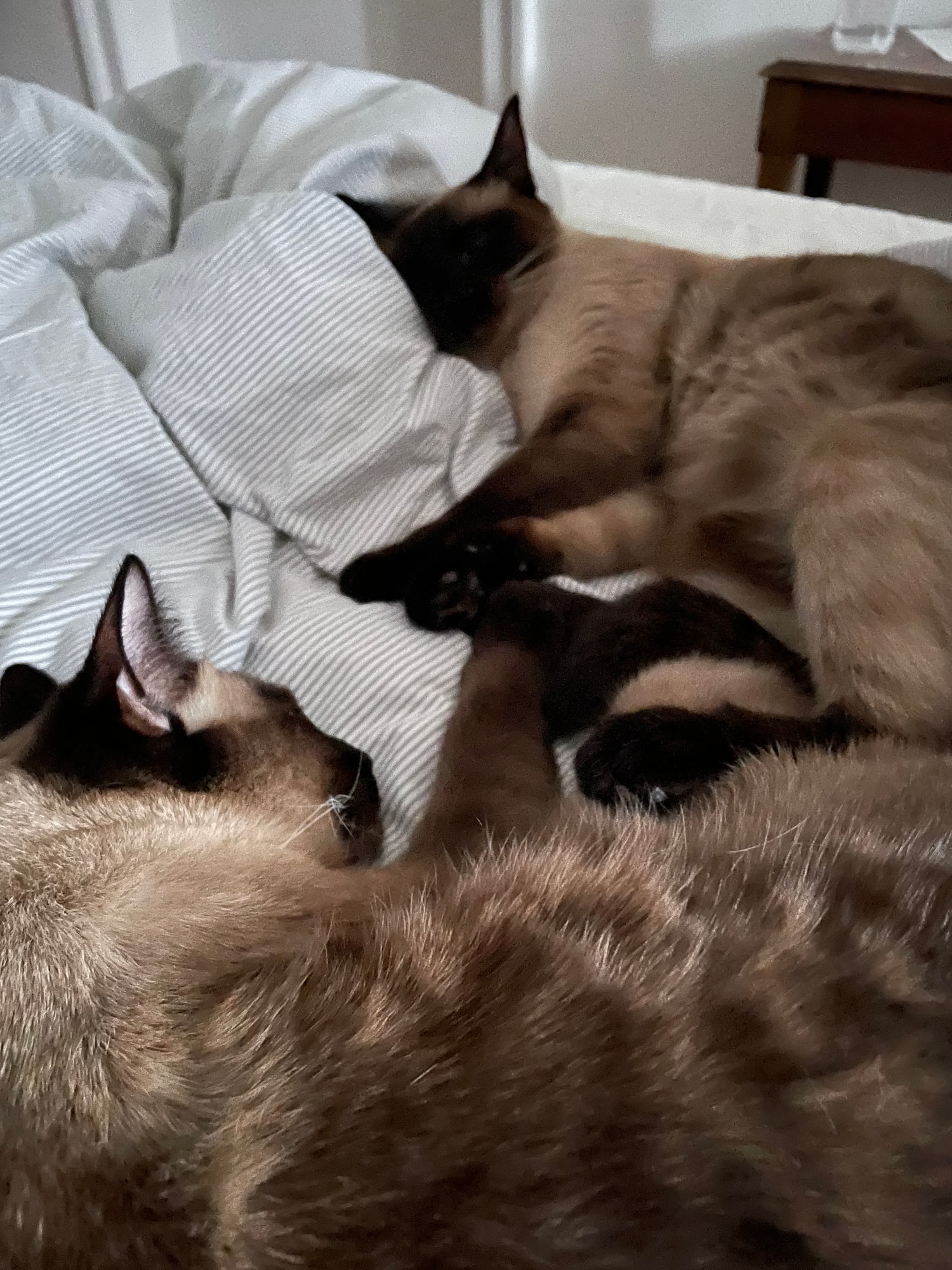
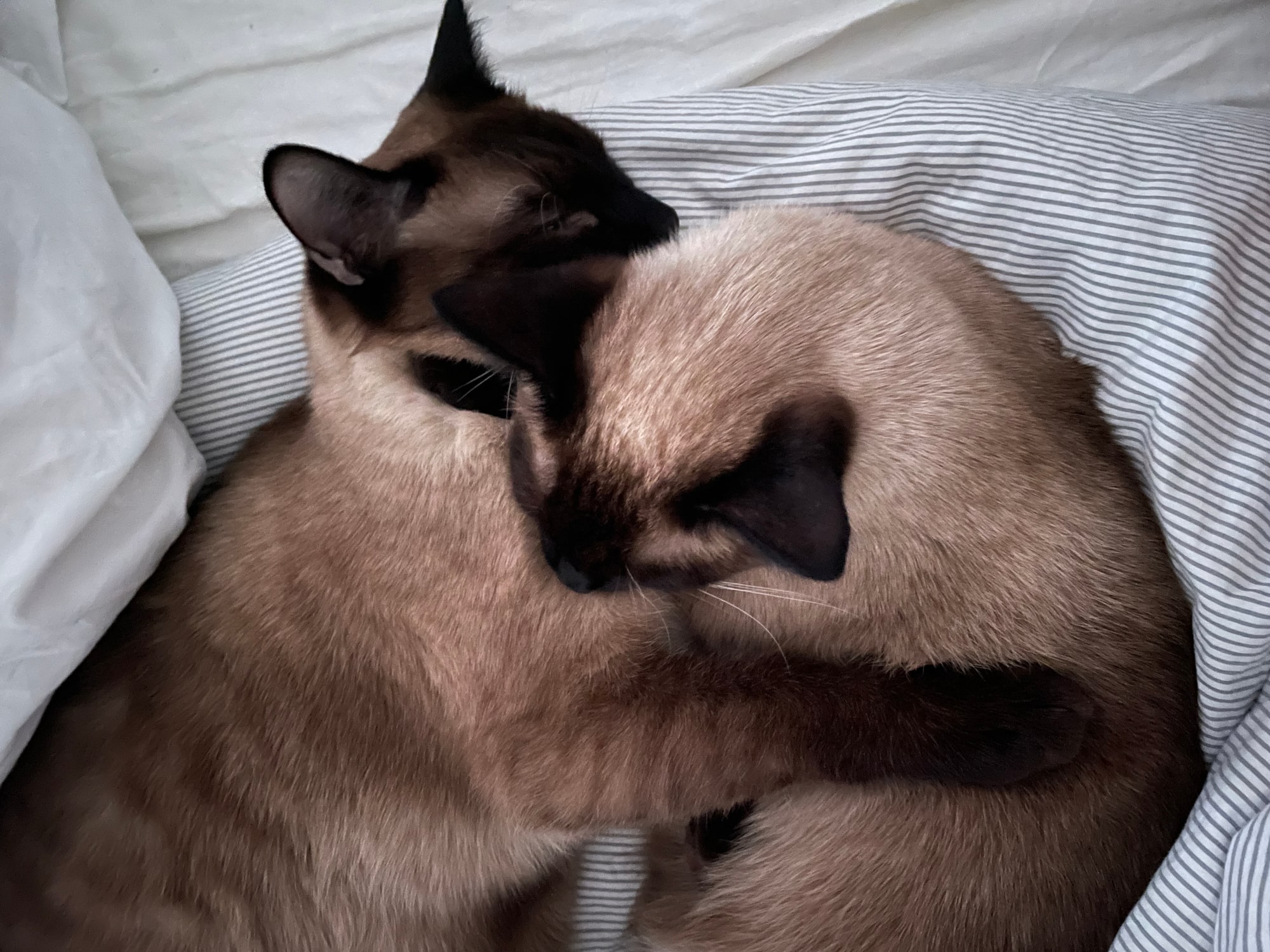
The title refers to the purring of my cats at a particular moment of the day. These are real moments from my life, from different evenings and even different years, with people I know.
What concerned me was staying close to the experience. I wanted to feel as I did when I was in that moment, or when I saw it.
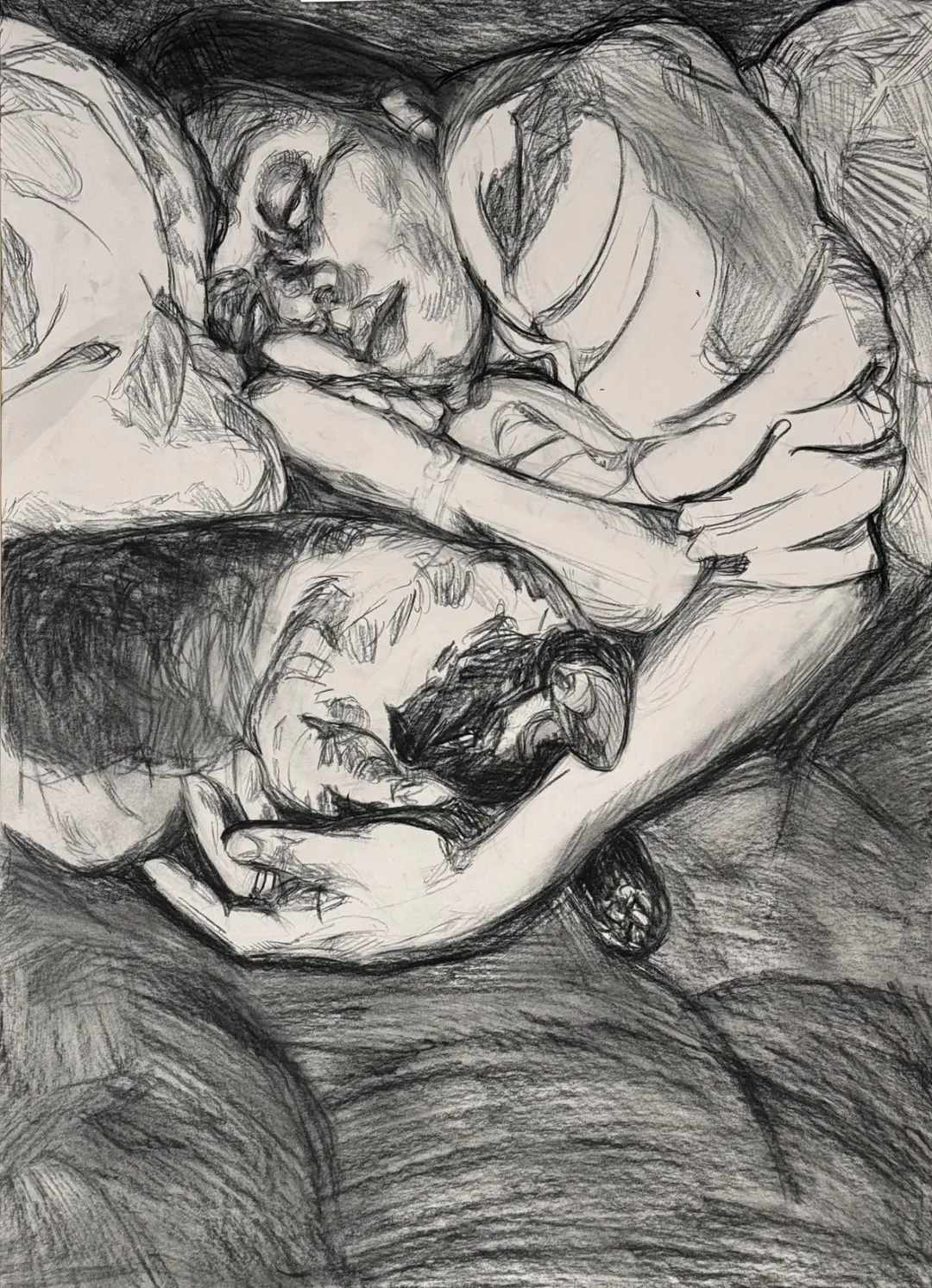
Charcoal on paper
Could you walk us through how a painting develops?
I might sketch someone from life, or take a photograph and sketch from there. I stretch my own canvases and make an underpainting.
I rarely do studies unless it’s a larger piece. For the painting of the women in the lagoon, I did some sketching, but generally I don’t like too much preparation.
The most important thing for me is to stay interested. If I exhaust the idea in a study, I can lose that.
It’s like preparing your own food. You’ve smelled it and tasted it while making it, and then it isn’t surprising anymore. That’s how it feels to me.
Usually, the first draft becomes the painting. I think a lot about composition and how to structure it, but what really interests me is the people. Painting the faces is my favourite part.
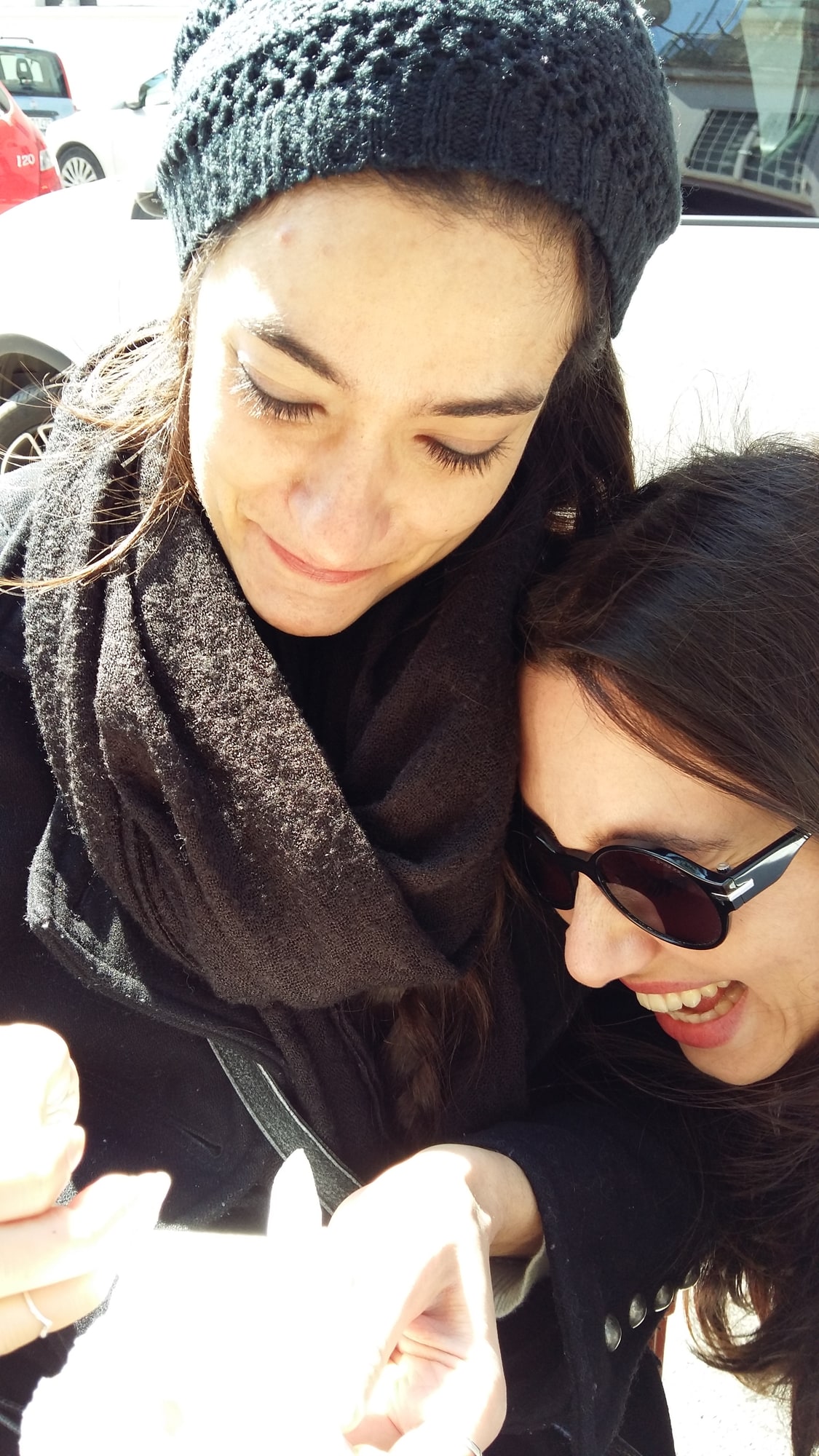
You leave visible brushstrokes and areas that feel unresolved. How do you know when to stop?
I don’t always know.
Sometimes I can see that something is exactly what I need, and I know not to touch it.
Other times, to be frank, I stop because I’m not interested anymore. There’s a moment when I feel the life dimming, and continuing would mean overworking it.
I need to be intrigued. I need to be interested. If I’m not, I have to let it go.
How do you choose the colours around your subjects?
Part of it happens without much conscious thought. I look at a lot of art, and I’m sure things sink in. Sometimes something I think is my idea may be something I’ve seen.
But colours also make me feel a certain way.
There was a time when I wasn’t feeling good, and I noticed I was using very sugary colours—pinks and bright colours. It was almost like eating chocolate to make yourself feel better.
Now my palette is much darker, but I feel great.
It mostly has to do with how I want to feel while I paint. That’s why I say the process is often about pleasing myself.
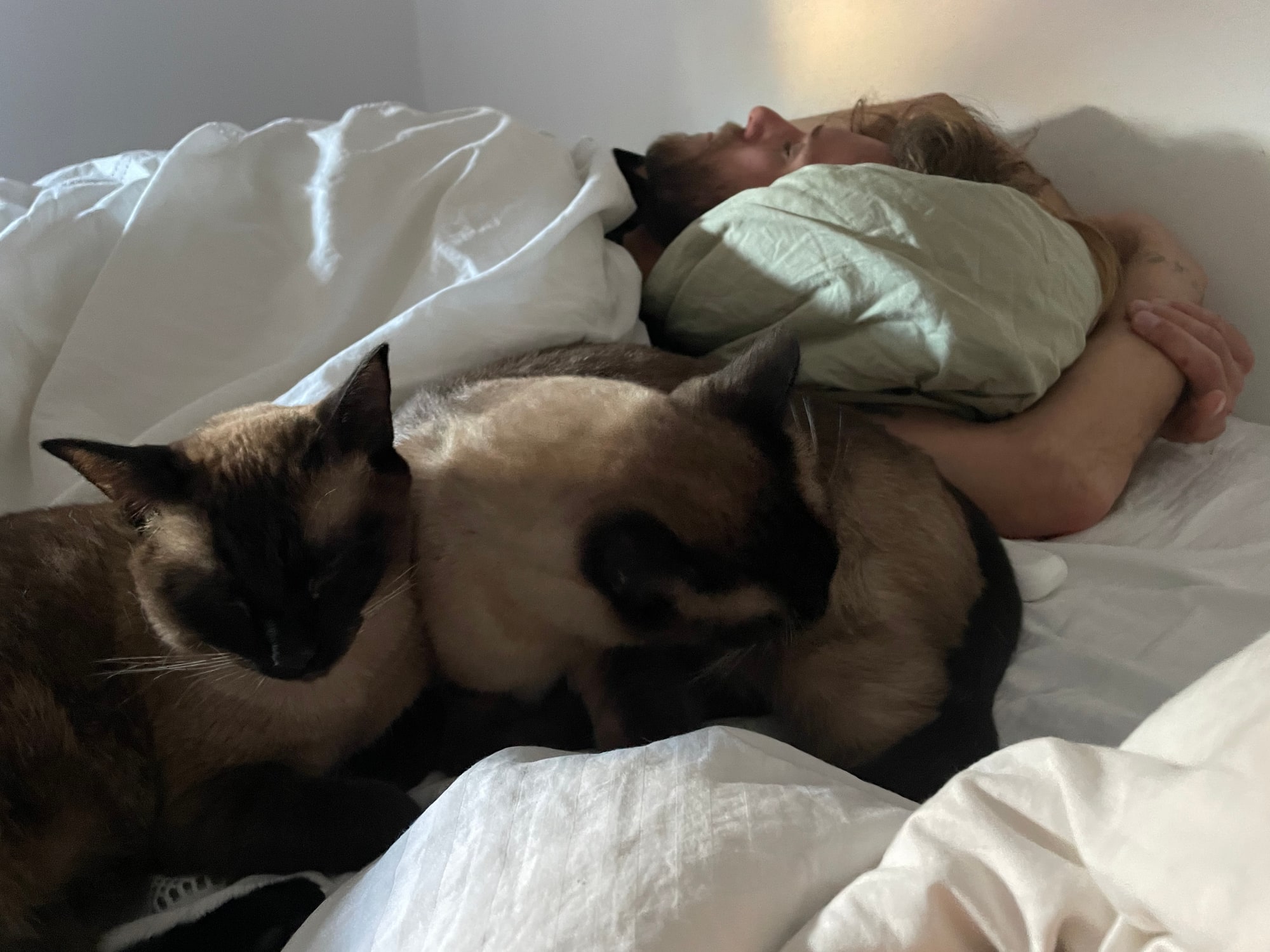
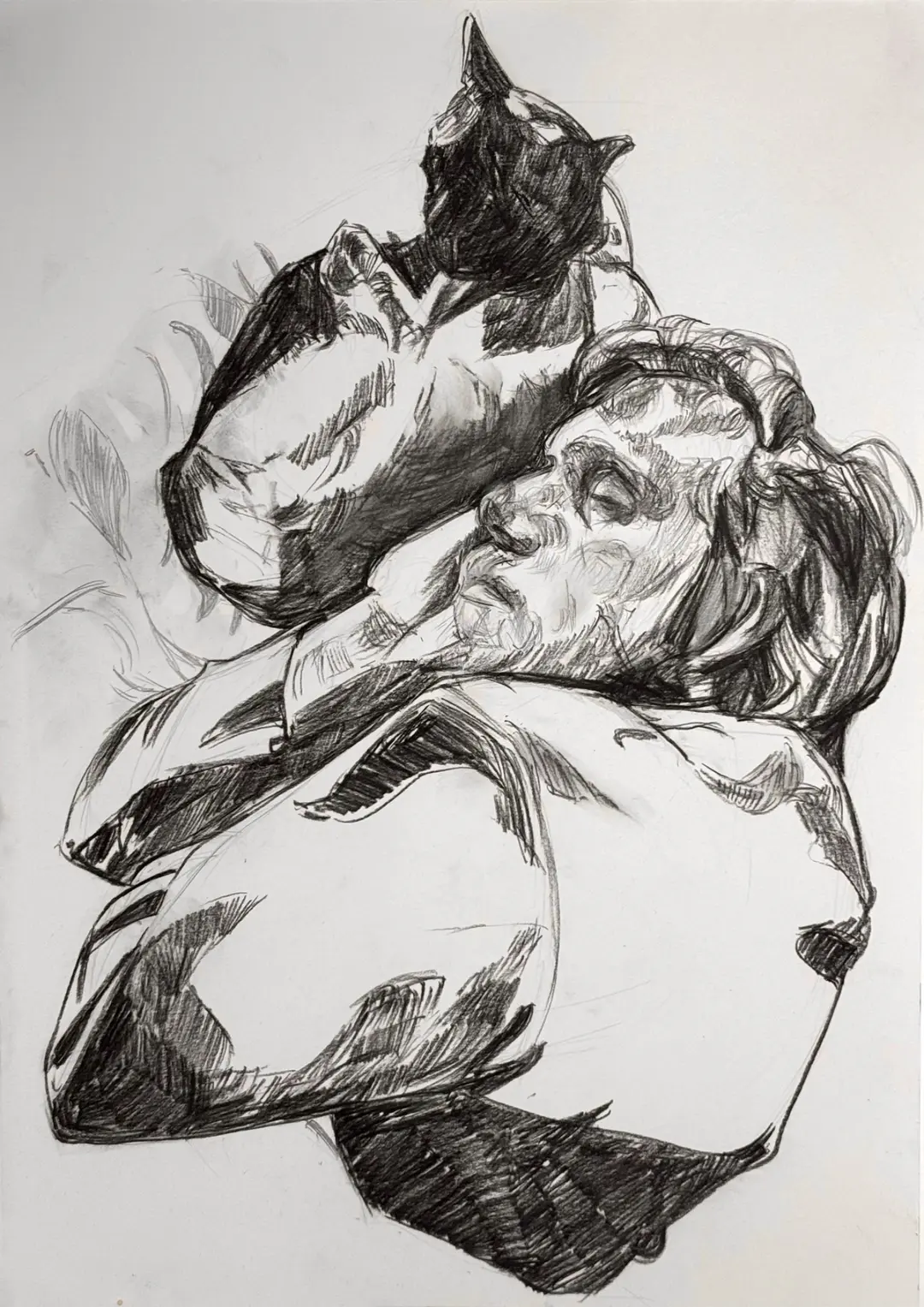
Charcoal on paper
Building a life around painting
Your work was selected for the Royal Institute of Oil Painters’ annual exhibition in London. What did that moment mean to you?
The day I received the email saying I was in the exhibition, I was wondering whether I should continue.
I had a day job at the time, and it felt like things weren’t moving. I was thinking, “I don’t know how I can do this.”
Then the email arrived, and I thought, “Okay, I’ll keep going a little while longer.”
Sometimes you do need a little external recognition.
The exhibition was a great experience. I met interesting artists and was inspired by some of them. Being admitted to a juried exhibition was also useful for future applications.
But what stays is that you remember to keep going.
Has a personal connection helped open a professional door for you?
I’m not good at networking. I find it difficult and embarrassing.
One connection came through someone I became friends with. She saw my work and said, “I have to show this to somebody.”
She opened the door for me, and then it was easier. I was lucky.
What would make a gallery the right partner for you?
I would love a gallery that also represents other figurative artists. That’s important to me.
I also need to feel safe. I want us to establish a relationship that feels safe.
There are different elements to finding the right gallery, but that relationship matters a lot.
Connection and what comes next
You first discovered Artsume through a gallery’s open call. How have you been using it since?
I found it because I wanted to apply to Abbozzo Gallery in Canada. They had a running open call, and the application was through Artsume.
I browsed a little, really liked it, and now I use it quite a lot.
I use it to share my portfolio. I like sharing the link because it’s straightforward and easy for people to navigate.
What are you working on now that feels different from what you’ve done before?
I’m trying to think more about how to bring the emotion I feel and see in my subjects into the composition as well.
That’s a struggle for me because I’m so interested in the people. If I could only paint people on a white background, I would.
But I also don’t want to. I feel like there’s more, and I have to access that. That’s what I’m working on.
What would you tell a younger version of yourself?
To care less about rejection, and to keep creating.
Don’t get stuck overthinking. And if you feel like you can’t create, take a break and live something completely different.
Sometimes we don’t realize that we’ve lost vitality, or lost something we need.
Live something, feel alive again, and then go back and create.
Ultimately, what do you want to build through your work?
I hope to create a space for empathy and reach people in meaningful ways. Having my work in collectors’ hands and public spaces allows me to sustain and grow my practice over time. Selling is an important part of that but it’s about finding the right balance between the commercial side of my work and staying connected to what makes me happy.
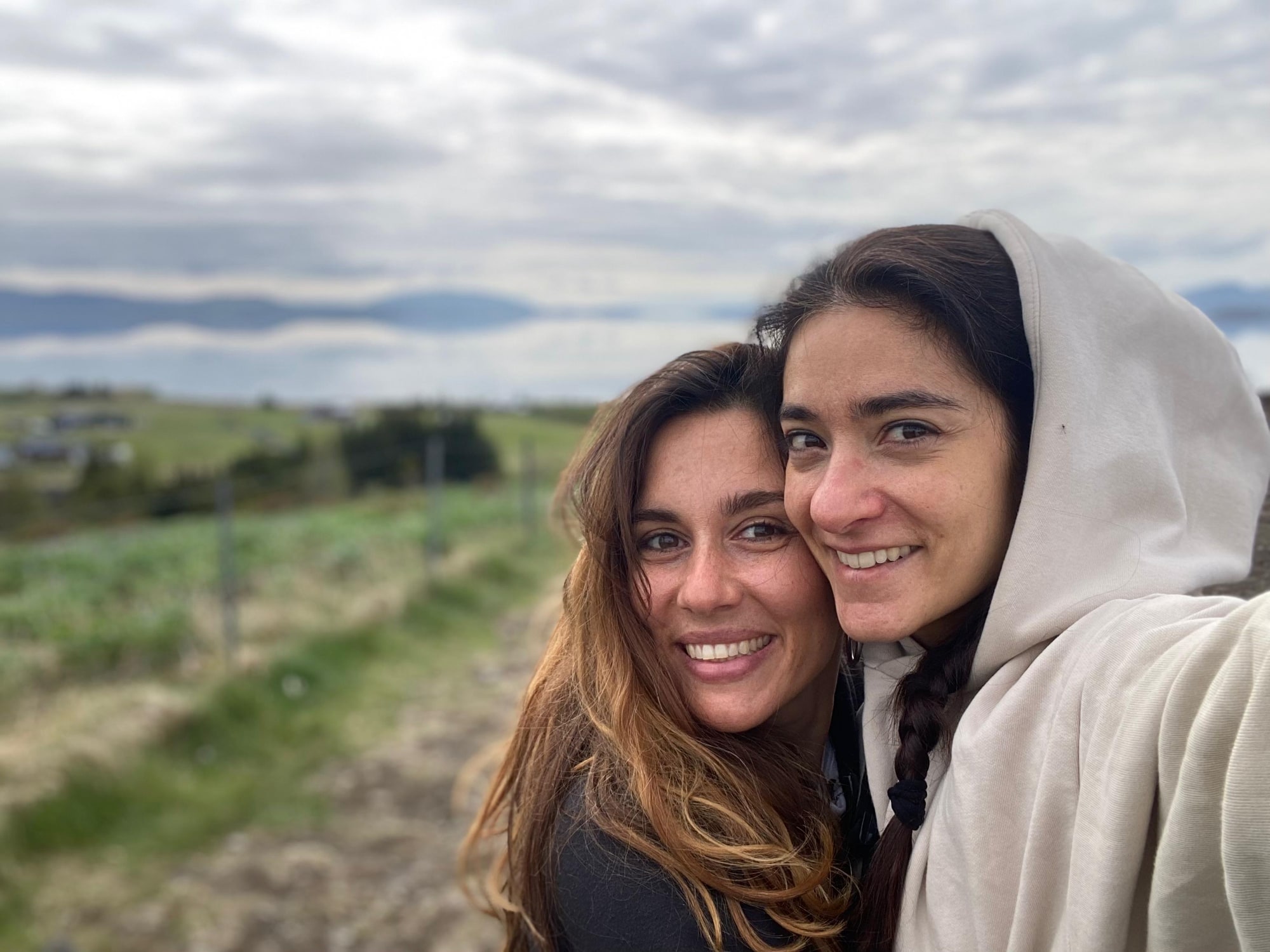
Explore Daniela Savarese’s portfolio and connect with her on Artsume.