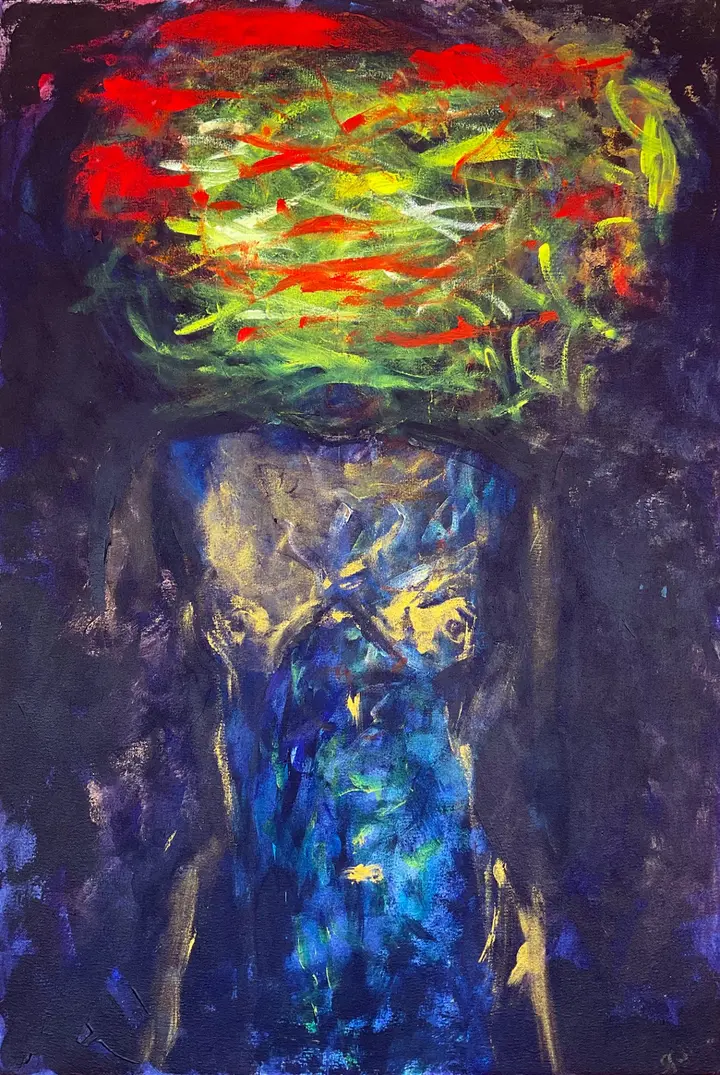
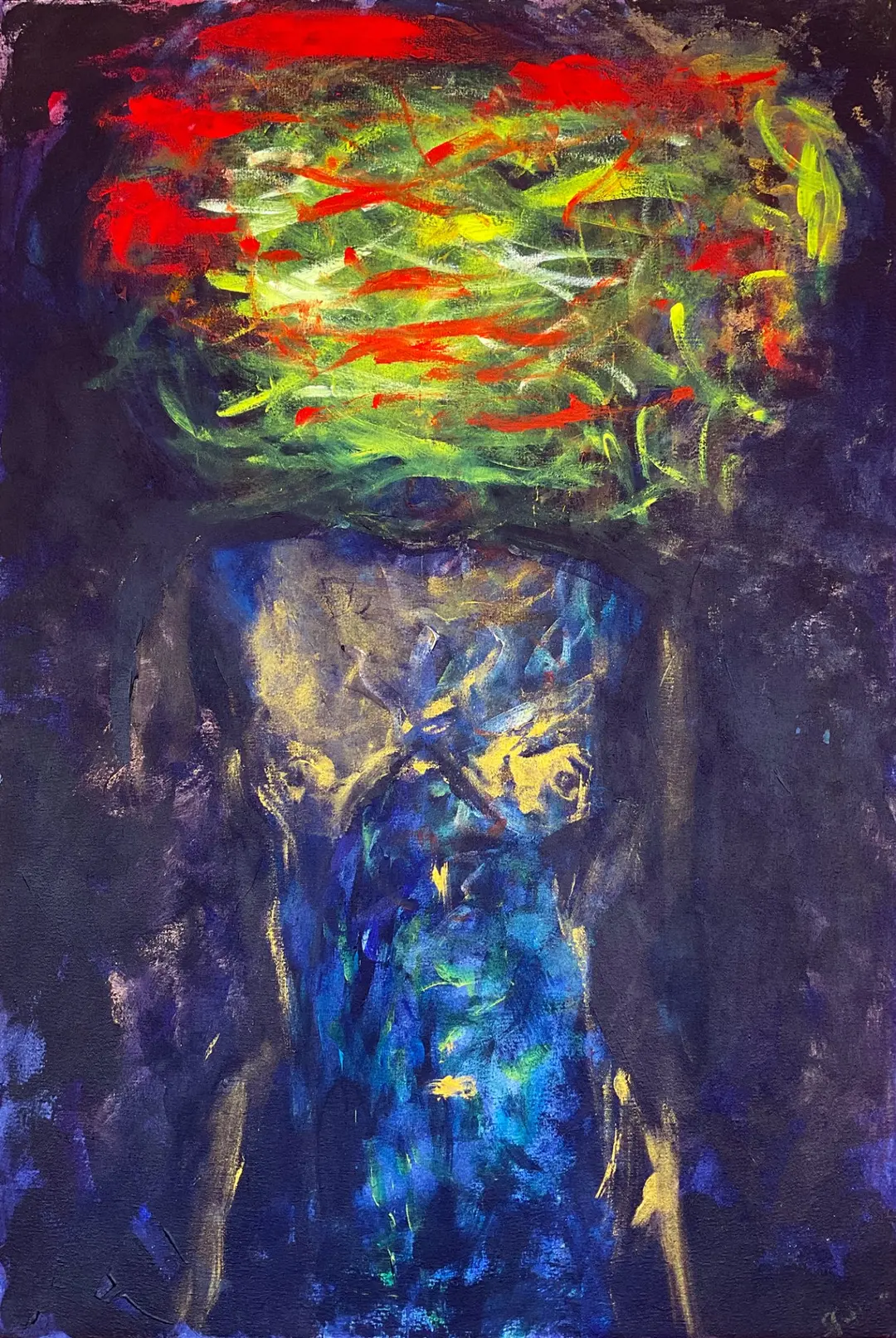
Self Portrait at 39 Years, 361 days, 2026
Acrylic on canvas
Details
- Dimensions
- 35 x 24 inches
Description
A figure emerges from deep violet and midnight blue —bodily, present, unmistakably alive —crowned not with a face but with an eruption of colour: a storm of red, yellow and white, blazing upward and outward like fire, like foliage, like thought itself uncontained. This painting has lived many lives. It began as a night vision —a boogeyman, a chaos figure summoned after a strange, sleepless night of anxiety and overthinking. While painting into her, she became a witch. Then a Black Madonna: the dark feminine, outcast, written out of history through the erasure of her image. And then, most recently, the face was painted over —and something was finally freed. Without a face, the figure becomes every woman at the threshold. The body carries its own knowing. I painted over her face and suddenly this painting came to life and excited me. Better without a head, I thought. A state I sometimes feel that I paint better in - not overthinking or over-analysing. Instinctive, expressionist, guttural. That's the whole story, in a way. Everything beneath —the boogeyman, the witch, the Black Madonna —is still there in the layers. The painting holds all of it. But the moment I stopped trying to give her a recognisable face, she stopped being a character and became something closer to the truth of how I felt. The Black Madonna is a figure who has always interested me — the dark feminine who was not destroyed so much as buried. Her image defaced, her story rewritten. And yet she persists, as archetypes do, in the layers beneath the official version. When I completed this in April 2026, I would turn 40 in four days. This is a self portrait without a self-image —which feels exactly right. The figure I am becoming doesn't have a fixed face yet. What she has is that crown of wild colour, that body full of pattern and memory, and the knowledge that she has already survived every previous version of herself and no longer has to be defined.